ESB 4.28 Review: 1.1-Inch Sonatex Silk Dome Tweeter at ₹15,990

Updated: Jul 8
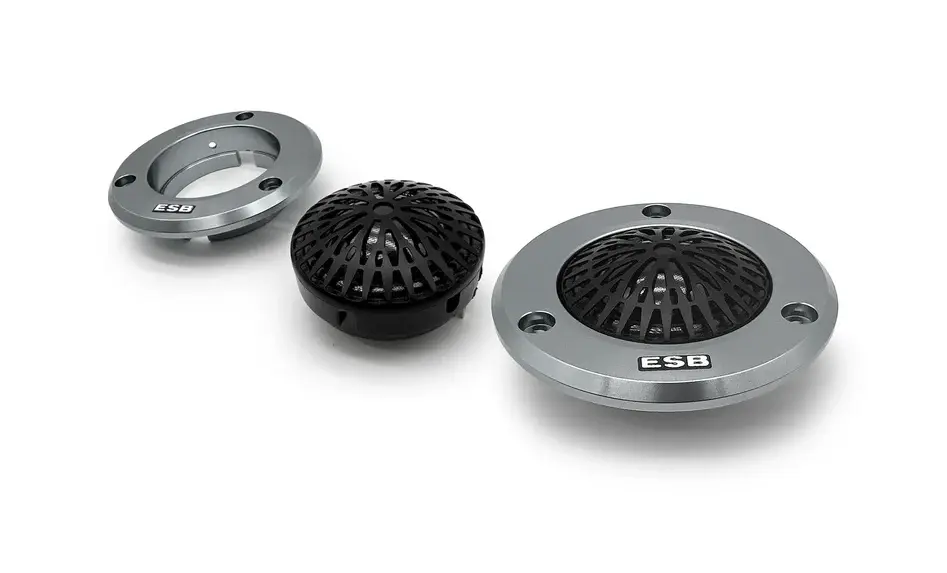
The ESB 4.28 is a standalone 1.1-inch/28mm dome tweeter from the ESB Quattromila 4000 Series at ₹15,990 per pair — built with a Sonatex silk dome, high-grade N52 neodymium magnet, and an extremely lightweight voice coil. Rated at 100W RMS / 200W peak with a 1.5 kHz – 22 kHz frequency response and an exceptional 93.5 dB sensitivity, the ESB 4.28 is the serious-tier tweeter for custom component builds: it crosses low enough to meet a midrange or mid-woofer gracefully, plays loud enough to keep pace with high-sensitivity systems, and carries the refinement that separates the Quattromila tier from the enthusiast series below it.
Key Takeaways
₹15,990 per pair — standalone Quattromila tweeter for custom 2-way and 3-way front stages.
1.5 kHz – 22 kHz response — the low crossover capability that raises soundstage height in a real car.
93.5 dB sensitivity with 100W RMS handling — loud, dynamic, and easy to match with high-efficiency woofers.
Sonatex silk dome + N52 neodymium + extremely lightweight voice coil — flagship-adjacent materials at mid-tier price.
ESB 4.28 Full Specifications
Specification | Value |
|---|---|
Type | 1.1" / 28mm dome tweeter |
Dome | Sonatex silk |
Magnet | High-grade N52 neodymium |
Voice coil | Extremely lightweight |
Impedance | 4 Ω |
RMS / Peak power | 100W / 200W |
Frequency response | 1.5 kHz – 22 kHz |
Sensitivity | 93.5 dB @ 2.83V / 1m |
MRP (India) | ₹15,990 |
The 1.5 kHz Number: Why It Defines This Tweeter
Most 25mm tweeters at mainstream prices are comfortable crossing at 2.5–3.5 kHz. The ESB 4.28's rated response extends down to 1.5 kHz — a full octave lower — and that single number defines what this tweeter can do that cheaper units cannot. In a car, the tweeter sits at A-pillar or sail-panel height while the woofer sits low in the door. Every frequency assigned to the tweeter renders at eye level; every frequency left to the woofer renders at shin level. A tweeter that crosses at 1.8–2 kHz instead of 3 kHz lifts the entire vocal presence region — the range that determines where a singer appears to stand — out of the door and onto the pillar.
The engineering that makes 1.5 kHz possible: the 28mm dome's larger radiating area moves enough air at lower frequencies to avoid strain, the N52 neodymium motor (the highest common commercial neodymium grade) provides the magnetic force to control the dome at higher excursions, and the extremely lightweight voice coil keeps moving mass low so sensitivity stays at 93.5 dB despite the extended bandwidth. This combination is what you are paying for over an entry tweeter.
Sonatex: The Dome Material
Sonatex is a treated silk fabric dome material used in serious European tweeter manufacture. Its virtue is controlled internal damping: where metal domes ring at their breakup frequency and hard plastics sound glassy, a damped silk dome dissipates resonant energy within the fabric itself. The audible signature is treble that stays smooth and fatigue-free at any listening level — cymbals decay naturally, sibilants stay crisp without spitting, massed strings retain texture instead of hardening. Sonatex specifically is chosen for consistency across production units and stability in automotive temperature swings, which matters in Indian cars where pillar-mounted tweeters routinely see 70°C+ surface temperatures behind glass.
93.5 dB Sensitivity: The System-Matching Advantage
A tweeter's sensitivity must meet or exceed the woofer it partners with, because attenuating a tweeter (with crossover resistors) is easy while boosting one is impossible passively. At 93.5 dB, the 4.28 sits above virtually every quality mid-woofer on the market — including ESB's own 4.165 at 92.5 dB — meaning it can be padded down precisely to match rather than becoming the system's bottleneck. For active builders, the high sensitivity means small amplifier channels (30–50W) drive it to full system output with headroom to spare.
Three Builds Around the ESB 4.28
Quattromila 2-way: pair with the ESB 4.165 mid-woofer for the natural in-series combination — the 4.165's response reaches 6 kHz, overlapping generously with the 4.28's 1.5 kHz floor for flexible crossover placement anywhere from 2–4 kHz.
Custom 3-way: the 4.28 tops a 3-way stage over the 4.75 midrange (or buy them pre-combined as the 4.UMA). Cross tweeter-to-mid around 4–5 kHz where both drivers are loafing.
Tweeter upgrade in an existing system: the 4.28 is a legitimate drop-in upgrade for enthusiasts running Tremila or comparable component sets who want flagship-adjacent treble without replacing the whole front stage. Run it active or have a passive network adjusted for its sensitivity.
Integration Notes
Despite the 1.5 kHz rated floor, cross conservatively in high-output systems: 2 kHz at 12 dB/octave or 1.8 kHz at 24 dB/octave preserves excursion headroom while keeping the soundstage-height benefit. Aim the tweeters at the opposite-side headrest for the best left-right balance compromise in a two-seat listening scenario. A DSP with per-channel time alignment — see our Onkyo R-MS66 review — unlocks the imaging precision this tweeter is capable of; its resolution is high enough to expose alignment errors lesser tweeters blur over.
The Bottom Line
The ESB 4.28 is the tweeter for builders who understand that crossover frequency is soundstage height. The Sonatex dome delivers fatigue-free refinement, the N52 motor and lightweight coil deliver 93.5 dB of easy dynamics, and the 1.5 kHz floor delivers system-design freedom that mainstream tweeters simply do not offer. At ₹15,990 per pair it anchors the Quattromila component philosophy: individual drivers good enough to build anything around.
Frequently Asked Questions
Can the ESB 4.28 really be crossed at 1.5 kHz?
That is its rated floor. In practice, cross at 1.8–2 kHz with steep slopes for high-volume systems, reserving 1.5 kHz for moderate-level SQ builds. Even at 2 kHz you are a full octave below typical tweeters — the soundstage benefit is substantial.
Does the ESB 4.28 come with a crossover?
No — it is a raw driver for custom builds. Run it active from a DSP, or have your installer build a passive network matched to your chosen woofer.
Is the ESB 4.28 an upgrade over the tweeter in the Tremila 3.6K2?
Yes — the Sonatex dome, N52 magnet grade, higher sensitivity, and lower crossover capability all step beyond the Tremila 3.28. It is a sensible tweeter-only upgrade path for existing Tremila owners running active systems.
Comments