ESB 4.6C Review: Quattromila 6.5-Inch Coaxial Speaker at ₹44,990

Updated: Jul 8
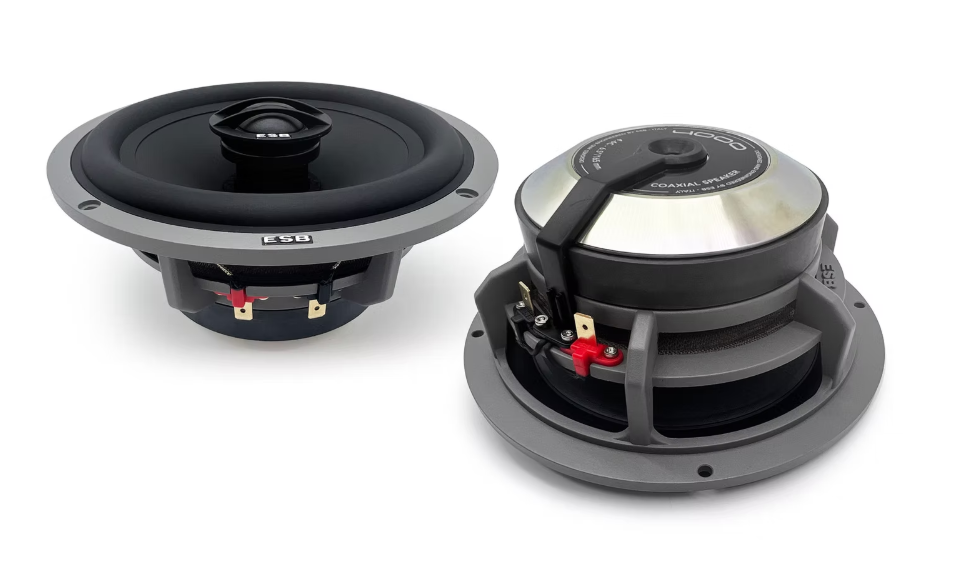
The ESB 4.6C is the flagship coaxial of ESB's mainstream India range — a 6.5-inch/165mm two-way speaker from the Quattromila 4000 Series at ₹44,990 that mounts a silk dome tweeter over the same long-fiber unbleached pulp cone and die-cast aluminum alloy basket as the 4.165 mid-woofer. Rated at 100W RMS / 200W peak with a 55 Hz – 22 kHz frequency response and 92.0 dB (tweeter) / 92.5 dB (woofer) sensitivity at 4-ohm impedance, the ESB 4.6C answers a question few manufacturers take seriously: what does a coaxial sound like when it is built from serious-tier component parts instead of cost-reduced ones?
Key Takeaways
₹44,990 — the most capable coaxial in ESB's mainstream range, built on genuine Quattromila component hardware.
100W / 200W RMS / Peak, 55 Hz – 22 kHz, 92+ dB sensitivity — component-class specs in a drop-in format.
Same unbleached pulp cone and die-cast aluminum basket as the 4.165 woofer — this is not a de-contented sibling.
For premium factory-location installs where pillar modification is off the table but sound quality is not negotiable.
ESB 4.6C Full Specifications
Specification | Value |
|---|---|
Type | 6.5" / 165mm 2-way coaxial |
Tweeter | Silk dome |
Cone | Long-fiber unbleached pulp |
Basket | Die-cast aluminum alloy |
Magnet | Y35 ferrite |
Impedance | 4 Ω |
RMS / Peak power | 100W / 200W |
Frequency response | 55 Hz – 22 kHz |
Sensitivity | 92.0 dB (Tw) / 92.5 dB (Wf) @ 2.83V / 1m |
MRP (India) | ₹44,990 |
A Coaxial Built from Component Parts
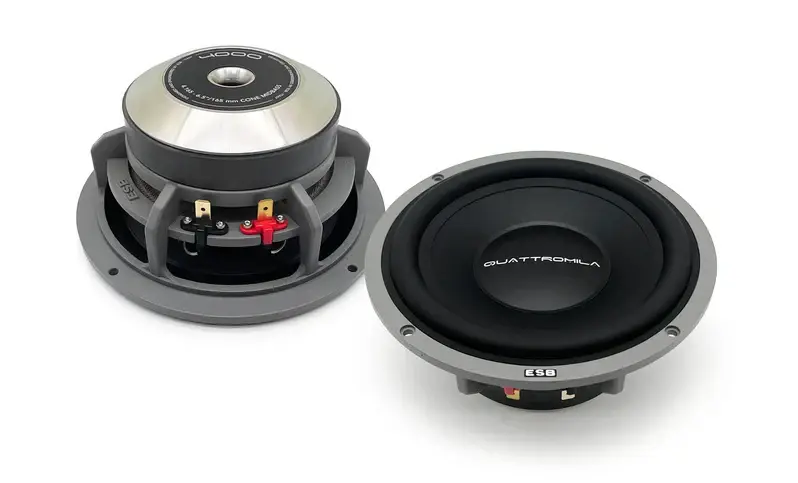
The 4.6C shares its fundamental hardware with the 4.165 mid-woofer: the long-fiber unbleached pulp cone, the die-cast aluminum alloy basket, the Y35 ferrite motor. ESB then mounts a silk dome tweeter coaxially at the cone's apex. This construction inverts the industry norm — most coaxials are built down to a price with hardware their component siblings would not recognize, while the 4.6C is built from the component driver itself. The consequences are exactly what the parts predict: 55 Hz midbass extension identical to the standalone woofer, the same uncolored pulp-cone midrange, the same structural composure at high drive, and matched 92+ dB sensitivity between tweeter and woofer sections for coherent tonal balance without heavy crossover attenuation.
The Coaxial Geometry: One Genuine Advantage, One Honest Limit
Mounting the tweeter at the woofer's acoustic center gives the 4.6C something even component sets struggle to achieve: a point-source radiation pattern. Both drivers emit from the same location, so the crossover region has none of the phase interference that separated drivers produce — conceptually, the coaxial is the UMA idea applied at the woofer position. Off-axis response is unusually consistent, which matters in a car where nobody sits on-axis to a door speaker.
The honest limit is unchanged by build quality: the entire point source sits low in the door. The soundstage renders at door height — coherent, detailed, tonally correct, but low. No coaxial escapes this geometry. Buyers choosing the 4.6C should choose it knowing that a Tremila 3.6K2 component set at ₹29,990 will image higher, while the 4.6C will out-resolve it tonally. Which trade matters more depends entirely on your installation constraints.
Who the ₹44,990 Coaxial Is Actually For
Premium vehicles where modification is prohibited. Leased German sedans, company cars, and resale-sensitive luxury vehicles cannot accept pillar drilling — but their owners often have the budget and the ear for serious sound. The 4.6C is the ceiling of what a no-modification install can achieve in the ESB range at mainstream pricing (only the exotic tiers go further).
Rear fill in flagship systems. Behind a Quattromila or Cinquemila front stage, the 4.6C provides rear fill that genuinely matches the front's tonal signature — the same cone material, the same motor philosophy. In high-end builds where every seat matters, this coherence is worth the price.
The single-upgrade audiophile. For the buyer who will make exactly one change to their car — no amp rack, no DSP project, no fabrication — the 4.6C on a quality head unit or modest amplifier is the largest single-step improvement ESB's mainstream catalog offers in a factory hole.
Amplification and System Notes
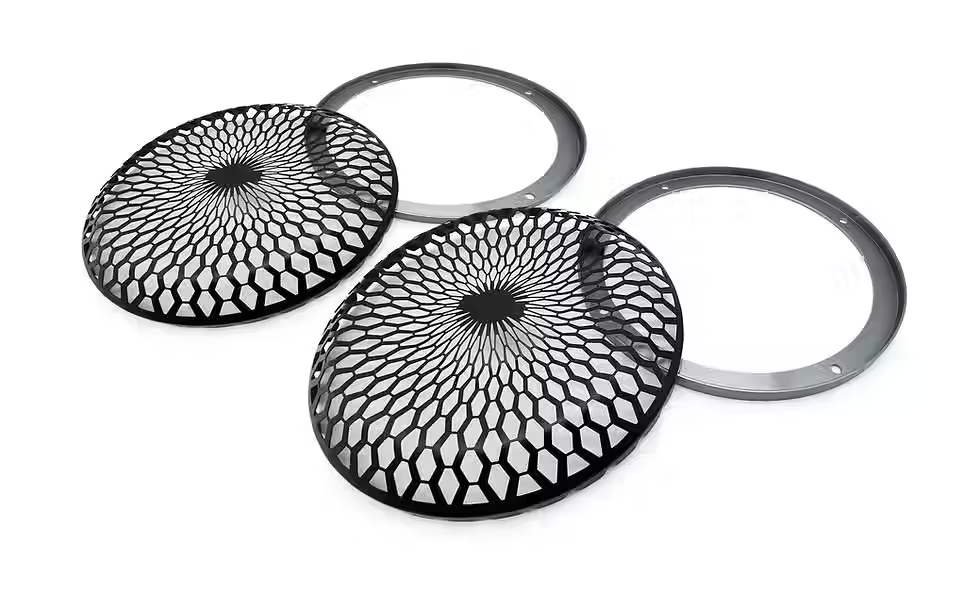
The 92+ dB sensitivity means factory head units drive the 4.6C respectably, but ₹44,990 of driver deserves better: a clean 60–100W per channel reveals what the die-cast structure and 100W rating exist for. Door deadening at ₹3,000–5,000 per door is proportionally trivial against this driver's price and disproportionately audible — the pulp cone's low-level resolution is exactly what panel resonance masks. A DSP adds EQ and (for rear-fill use) the fade and delay control that keeps the front stage dominant; see our Onkyo R-MS66 review. The optional 6.5" CNC grille (₹15,990) suits exposed premium installs.
The Bottom Line
The ESB 4.6C is what happens when a manufacturer refuses to treat the coaxial as a compromise category. Component-grade cone, basket, and motor; matched high sensitivity; genuine 55 Hz – 22 kHz bandwidth; and the point-source coherence that coaxial geometry uniquely provides. It cannot raise the soundstage — no coaxial can — but within the factory-location format it is the finest speaker in ESB's mainstream catalog. For premium no-modification installs and flagship rear fill, it is the honest answer at ₹44,990.
Frequently Asked Questions
Why does the ESB 4.6C cost the same as the 4.165 woofer pair?
Because it essentially is the 4.165 with a coaxial silk dome tweeter engineered onto it — same cone, basket, and motor class. You are paying for component hardware in a drop-in format, not a budget derivative.
Should I buy the 4.6C or a component set at this price?
If your install allows pillar tweeter mounting, a component set images higher — that geometry advantage is real. Buy the 4.6C when modification is off the table, for premium rear fill, or when point-source coherence and drop-in simplicity outweigh stage height for your use.
Does the ESB 4.6C work on a factory head unit?
Yes — the 92+ dB sensitivity performs well on stock power. But at this driver tier, a modest amplifier (60–100W per channel) is strongly recommended to hear what you paid for.
Comments