ESB 4.UMA Review: Quattromila 2-Way Mid-High Unit at ₹69,990

Updated: Jul 8
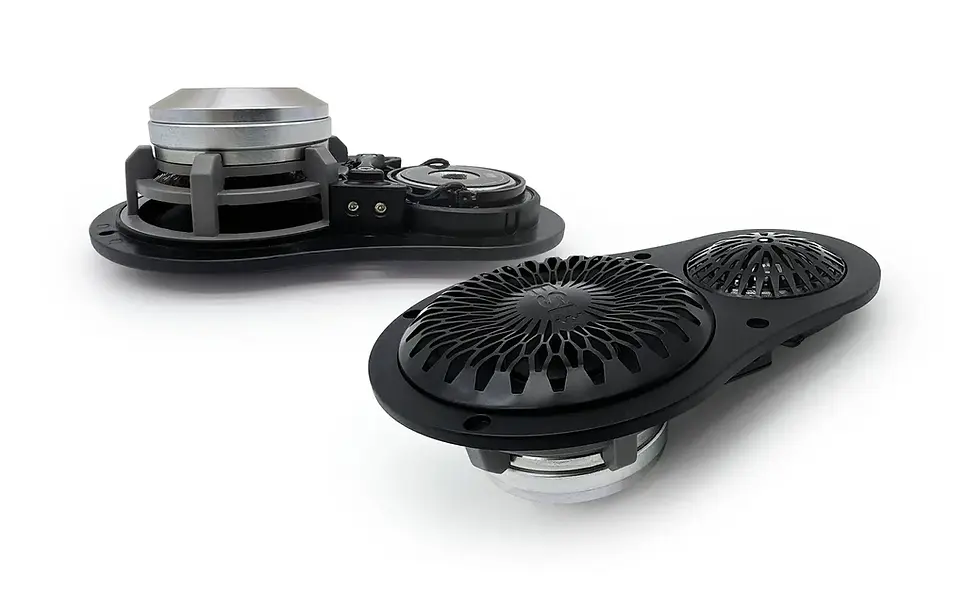
The ESB 4.UMA is the 2-way mid-high unit of the ESB Quattromila 4000 Series at ₹69,990 — combining the 4.28 1.1-inch Sonatex silk dome tweeter and the 4.75 3-inch long-fiber paper midrange in a single precision flange. It is the direct descendant of the UMA (Unità Medio Alti) concept ESB conceived in the 1970s: concentrate midrange and tweeter emissions at a virtual single point, minimizing the phase delays and irregularities that plague separated-driver installations at the crossover. Where the Tremila 3.UMA serves enthusiast 3-way systems, the ESB 4.UMA is the serious-tier implementation — N52 neodymium motors, die-cast aluminum midrange basket, and the driver quality to anchor front stages built around woofers up to the Quattromila 4.165 and beyond.
Key Takeaways
₹69,990 — the 4.28 tweeter (₹15,990 solo) and 4.75 midrange pre-combined in one phase-coherent A-pillar flange.
Combined coverage roughly 140 Hz – 22 kHz — the entire vocal and treble spectrum from one pillar-mounted unit.
Both drivers carry 100W / 200W RMS / Peak ratings with N52 neodymium motors — real dynamic capability at pillar height.
One mounting location, one flange, guaranteed left-right driver geometry — the install advantage is as real as the acoustic one.
ESB 4.UMA Specifications
Specification | Value |
|---|---|
Type | 2-way mid-high unit (UMA) |
Composition | 4.28 tweeter + 4.75 midrange |
Tweeter | 1.1" / 28mm Sonatex silk dome, N52 neo |
Midrange | 3" / 75mm long-fiber paper, die-cast alu basket, N52 neo |
Tweeter response | 1.5 kHz – 22 kHz, 93.5 dB |
Midrange response | 140 Hz – 12 kHz |
Power (each driver) | 100W / 200W RMS / Peak |
Impedance | 4 Ω per driver |
MRP (India) | ₹69,990 |
Why the UMA Geometry Beats Separated Drivers
The physics is worth restating precisely, because it is the entire reason this product exists. When a midrange and tweeter mount at different points on a pillar, sound from each travels a different distance to your ears. At the crossover frequency — where both drivers reproduce the same content simultaneously — that path difference becomes a phase offset, and phase offsets between two sources playing the same signal produce interference: partial cancellation at some frequencies, reinforcement at others, shifting with every centimeter of head movement. The audible symptom is a crossover region that sounds subtly hollow, imaging that smears when a vocal slides through 3–4 kHz, and a sweet spot the width of a fist.
The 4.UMA eliminates the geometry problem at its source: both drivers occupy one flange, their acoustic centers as close as physics allows, emissions concentrated at what ESB calls a virtual single point. The crossover region knits together without a detectable seam, and the sweet spot widens because the phase relationship between mid and tweeter no longer depends on where your head happens to be. Fifty years after ESB conceived the UMA for its home loudspeakers, this remains the most elegant solution to the mid-tweeter integration problem in car audio — and the reason the concept appears in the brand's EISA-award-winning flagship systems.
What the Quattromila Tier Adds Over the Tremila 3.UMA
Buyers comparing this unit to the Tremila 3.UMA (inside the 3.6K3U system, ₹69,990 complete with woofers) should understand the tier difference. The 4.UMA's tweeter is the Sonatex-domed 4.28 with N52 motor and a 1.5 kHz floor — where the Tremila tweeter crosses higher and carries a lower-grade motor. The 4.UMA's midrange is the 100W 4.75 with die-cast aluminum basket — double the Tremila midrange's power handling in a structurally superior frame. Both 4.UMA drivers reach 100W RMS; the unit as a whole plays louder, crosses lower, and resolves finer detail. The honest framing: the 3.6K3U buys a complete 3-way system for the price of this mid-high unit alone. The 4.UMA is for builders whose woofer, amplification, and tuning ambitions justify serious-tier drivers at pillar height.
Completing the System: The 4.165 Partnership
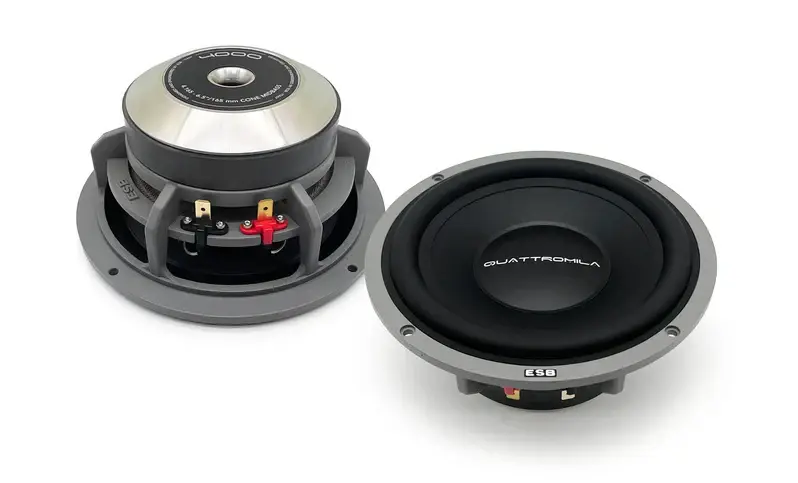
The natural woofer beneath the 4.UMA is the ESB 4.165 (₹44,990) — its 55 Hz – 6 kHz response overlaps the midrange's 140 Hz floor by more than an octave, allowing the mid-to-woofer crossover anywhere from 200–400 Hz. The complete Quattromila 3-way front stage (4.UMA + 4.165) totals ₹1,14,980 in drivers — positioned squarely between the Tremila 3.6K3U (₹69,990) and the Cinquemila 5.6K3UX (₹1,39,990, which adds an included level-adjustable crossover). Run the Quattromila stage active: six DSP channels, 80–120W per woofer, 50–80W per midrange, 40–60W per tweeter. See our Onkyo R-MS66 review for the processor entry point.
Installation Notes
The single-flange format is the install story: one mounting location per pillar, one aperture, one wiring exit — versus the two-location fabrication a separated mid and tweeter demand. Pillar pods for the UMA form factor are a known quantity for experienced fabricators; budget for custom pod work as part of the install. Aim each unit toward the opposite headrest for balanced two-seat imaging. Because both drivers per side share one housing, left-right geometry is guaranteed identical — DSP time alignment applies one delay per side for the whole unit, simplifying tuning meaningfully versus four independently-placed drivers.
The Bottom Line
The ESB 4.UMA is the serious-tier expression of ESB's defining idea: the mid-tweeter crossover belongs at a single point in space. The 4.28's Sonatex refinement and 1.5 kHz floor, the 4.75's die-cast-framed 100W authority, and the phase-coherent flange that has anchored ESB systems for five decades — combined at ₹69,990. For builders constructing a Quattromila 3-way, or upgrading the top of an existing serious system, this is the pillar unit that makes the soundstage happen.
Frequently Asked Questions
Do I need a crossover for the ESB 4.UMA?
The 4.UMA is designed for active operation — a DSP handles the tweeter-mid crossover and the mid-woofer crossover with independent channels per driver. Consult your ESB dealer regarding passive network options for your specific system configuration.
Is the ESB 4.UMA worth it over buying the 4.28 and 4.75 separately?
If your install puts mid and tweeter at pillar height together — yes, unquestionably. The single flange delivers the phase coherence that is the entire point, plus simpler fabrication. Buy separate drivers only when your design requires physically separated positions.
What woofer pairs with the ESB 4.UMA?
The Quattromila 4.165 is the in-series match, with over an octave of response overlap for flexible crossover placement. Any high-quality 6.5-inch mid-woofer with clean output to 300 Hz and 90+ dB sensitivity also integrates well in an active system.
Comments