ESB 3.WB8 Review: 8-Inch Active Subwoofer with Built-In 600W Amp at ₹54,990

Updated: Aug 21
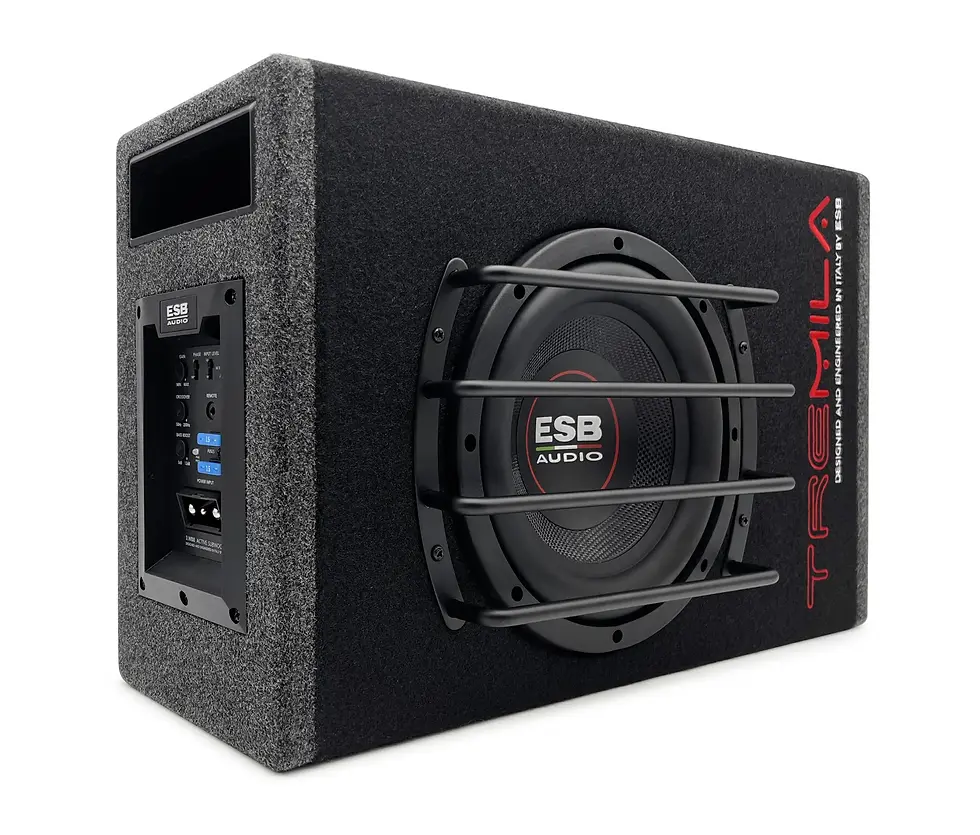
The ESB 3.WB8 is an 8-inch/200mm ported active subwoofer from the ESB Tremila 3000 Series at ₹54,990 — a complete plug-and-play bass solution combining driver, tuned MDF enclosure, and built-in 600W high-current Class D amplifier in a package only 15 cm deep. ESB built the 3.WB8 around a genuinely unusual engineering approach: a 0.25-ohm ultra-low-impedance, high-efficiency speaker (a design philosophy borrowed from electric machines) paired with an amplifier that omits the switching power supply stage entirely — producing less noise and more power from a smaller space. Rated 300W RMS / 600W peak with full onboard controls and a wired remote, the ESB 3.WB8 answers the most common question in Indian car audio: how do I get real bass without giving up my boot?
Key Takeaways
₹54,990 complete — driver, ported MDF enclosure, and 600W Class D amplifier in one 15 cm deep unit. No separate amp needed.
0.25Ω high-efficiency speaker + no-switching-power-supply amplifier — ESB's unusual architecture for more power, less noise, smaller space.
Full control set: variable gain, low-pass filter 50–200 Hz, bass boost 0–12 dB, phase 0–180°, auto power-on, wired remote included.
448 × 289 × 150 mm, 9.7 kg — fits behind seats, against boot walls, and in spaces no passive sub-plus-amp install can use.
ESB 3.WB8 Full Specifications
Specification | Value |
|---|---|
Type | 8" / 200mm ported active subwoofer |
Amplifier | Built-in 600W high-current Class D |
Speaker impedance | 0.25 Ω (high-efficiency design) |
Cone | Fiberglass / paper |
Magnet | Ferrite |
RMS / Peak power | 300W / 600W |
Low-pass filter | Variable 50 – 200 Hz |
Bass boost | 0 – 12 dB |
Phase control | 0° – 180° |
Auto power-on | Remote / DC offset / Auto |
Remote control | Wired, included |
Enclosure | MDF, ported |
Dimensions | 448 (W) × 289 (H) × 150 (D) mm |
Weight | 9.7 kg |
MRP (India) | ₹54,990 |
The 0.25-Ohm Architecture: Why It Is Genuinely Different
Most active subwoofers are conventional systems shrunk: a 2Ω or 4Ω driver, a compact Class D amp with a switching power supply that steps 12V battery voltage up to the rails the amplifier needs. That switching stage costs space, generates electrical noise, and loses efficiency as heat. ESB's 3.WB8 takes a construction approach the company describes as borrowed from electric machines: an extremely low impedance (0.25Ω), high-efficiency speaker that can be driven with high current directly at low voltage — allowing the amplifier to omit the switching power supply stage entirely.
The practical consequences are exactly what ESB claims: less noise (no switching stage means no switching artifacts injected into the signal), and higher power from a smaller space (the eliminated stage frees enclosure volume and thermal budget). It is the reason a 600W amplifier and a ported 8-inch driver coexist in a cabinet only 15 cm deep. This is not marketing repackaging of a standard design — it is a structurally different way to build an active subwoofer, and it is the defining reason to choose the 3.WB8 over generic underseat actives.
Ported, Not Sealed: The Output Decision
Nearly every compact active sub on the Indian market uses a sealed (or worse, free-air) alignment because sealed boxes are simpler to miniaturize. ESB built the 3.WB8 ported — accepting the engineering complexity of tuning a port within a 15 cm deep cabinet — because ported alignment produces meaningfully more output per watt in the 35–60 Hz region where music's bass foundation lives. An 8-inch driver has limited cone area; the port recovers output that the driver size concedes. Combined with the 600W amplifier's headroom, the result is an active 8 that produces bass comparable to larger passive setups, with genuine extension rather than the one-note midbass hump typical of underseat units.
The Control Set: Integration Without a DSP
The 3.WB8 carries a complete integration toolkit onboard. The variable low-pass filter (50–200 Hz) blends the sub with any front stage — set around 80 Hz for component systems like the Tremila 3.6K2, or higher (100–120 Hz) to support smaller factory speakers with limited midbass. The phase control (0–180°) corrects the cancellation that occurs when sub and front speakers are out of phase at the crossover — audible as bass that mysteriously weakens when both play together. The bass boost (0–12 dB) compensates placement losses, and should be used sparingly. The auto power-on (remote wire, DC offset, or signal sensing) simplifies wiring into any head unit, including factory units without remote leads. And the wired remote puts level control at the driver's seat — the feature owners use daily, adjusting bass per recording without touching amp gains.
Where the 3.WB8 Fits — and Where It Does Not
Buy the 3.WB8 if: boot space is non-negotiable (the 15 cm depth stands against a boot wall or behind SUV rear seats while leaving cargo area intact); you want single-box simplicity — power, ground, signal, done — with no amp rack, no enclosure fabrication, no component matching; or you are upgrading a factory system where the high-level-friendly auto-turn-on makes integration painless.
Buy a passive sub instead if: maximum output matters more than space. The 3.12D4 with a ₹20,000 mono amp costs less combined and produces substantially more bass from its far greater cone area — if you can spare the boot volume for its enclosure. The 3.WB8's ₹54,990 buys engineering density, not output supremacy. Be honest about which you need.
Installation Notes
Mount the unit firmly — a 9.7 kg cabinet becomes a projectile in hard braking if merely placed in the boot. Use the supplied brackets against the boot wall or seat back. Wire 8-gauge power and ground minimum for the 600W amplifier, with a fuse within 45 cm of the battery. Signal can come from RCA preouts or speaker-level inputs from a factory unit. Set gain conservatively, low-pass at 80 Hz to start, phase by ear (choose the position where bass is fullest from the driver's seat), and resist the bass boost until placement and phase are optimized.
The Bottom Line
The ESB 3.WB8 is the most technically interesting active subwoofer sold in India at its price — a genuinely different 0.25Ω, no-switching-supply architecture rather than a shrunken conventional design, in a ported 15 cm cabinet that produces real extension where competitors manage only midbass thump. At ₹54,990 it is not the cheapest path to bass, and a passive 12 will out-slam it for less money and more space. But for the buyer whose boot must stay a boot, this is the finest space-to-bass conversion in the ESB catalog.
Frequently Asked Questions
Does the ESB 3.WB8 need a separate amplifier?
No — the 600W high-current Class D amplifier is built in. It needs only power, ground, remote/signal connection, and mounting. The wired level remote is included.
Can the ESB 3.WB8 connect to a factory head unit?
Yes. The auto power-on options (DC offset or signal sensing) and input flexibility allow integration with factory systems that lack remote turn-on leads or RCA outputs.
Is the ESB 3.WB8 louder than a passive 10-inch or 12-inch sub?
No. An 8-inch driver, however well engineered, cannot match the cone area of the 3.10D4 or 3.12D4. The 3.WB8 wins on space efficiency, install simplicity, and noise-free integration — choose it for those reasons, not for maximum output.

Comments