Recoil MX8 Review: 8-Inch Pro Audio Coaxial, Specs and Crossover Advice

The Recoil MX8 is a pair of 8-inch (208 mm) pro audio coaxial speakers with an integrated bullet tweeter, 96.2 dB sensitivity and an 88 Hz to 20 kHz response. The listing rates it at 350 W RMS and 700 W peak at 4 ohm, but neither our listing nor Recoil's page says whether that is per speaker or per pair. The Indian MRP is ₹20,000, the same as the Recoil MX69 and above the ₹15,000 MX65. Recoil also publishes a crossover recommendation: an active setting of 80 Hz to 20 kHz at 12 dB per octave. See our Recoil MX8 product page.

Key takeaways
The 350 W RMS and 700 W peak ratings carry no per-speaker or per-pair label, although the title calls the product a pair. The 700 W is a peak figure, not RMS.
Recoil recommends an active crossover at 80 Hz to 20 kHz and 12 dB per octave, so a processor or electronic crossover belongs in the plan.
The 184 mm mounting diameter and 87 mm mounting depth appear on both our listing and Recoil's page.
We found no owner reviews, and Recoil's own page shows none.
Recoil MX8 specifications
Specification | Recoil MX8 |
|---|---|
Type | 8-inch (208 mm) pro audio coaxial with integrated bullet tweeter, sold as a pair |
RMS power | 350 W (per speaker or per pair not stated) |
Peak power, not RMS | 700 W (per speaker or per pair not stated) |
Impedance | 4 ohm |
Sensitivity | 96.2 dB (1 W / 1 m) |
Frequency response | 88 Hz to 20 kHz |
Cone | Pressed paper fibre |
Voice coil | 38 mm, titanium |
Magnet | Ferrite, 34.2 oz |
Mounting depth, diameter | 87 mm; 184 mm |
Recommended crossover | Active, 80 Hz to 20 kHz, 12 dB per octave |
Supplied | Grilles, screws and midrange/tweeter connection wires |
Warranty | Per Recoil's published terms (written for the US); confirm India terms with Recoil or its distributor |
India MRP | ₹20,000 |
These figures match Recoil's MX8 page, which has no warranty text; Recoil's terms are on its warranty page.
Two ways to read 350 W RMS
Both sources give 350 W RMS and 700 W peak with no label, and the product title says Pair. Read as per speaker, the pair takes 700 W RMS in total. Read as per pair, each speaker is rated 175 W RMS. Recoil's page for the 6x9 MX69 gives exactly 350 W RMS and 700 W peak as a pair rating, which would fit a per-pair reading here, but that is an inference, not something Recoil states for the MX8. Confirm the basis with Recoil or its distributor before sizing an amplifier.
For scale, the Recoil M1200.6 six-channel amplifier is listed at 145 W per channel at 4 ohm on our listing and Recoil's main site, with no label, while Recoil's US store gives 110 W per channel and calls it RMS. Both are below the 175 W each that a per-pair reading gives, and so below the 350 W each of a per-speaker reading. Every 3 dB of sensitivity is worth a doubling of amplifier power, so a speaker at 96.2 dB reaches a given level on far less power than a 90 dB one, and the RMS rating is headroom rather than a target. Whatever the answer, the listed 700 W figure is a peak rating and should not be used as RMS.
Setting up Recoil's active crossover advice
Recoil recommends an active crossover setting of 80 Hz to 20 kHz at 12 dB per octave. In practice that means a high-pass at 80 Hz, a little below the speaker's listed 88 Hz low end, and no low-pass until 20 kHz, with a subwoofer covering what is below. Without that high-pass, the driver is asked for bass it cannot reproduce, which wastes amplifier power and strains the voice coil. A processor with selectable slopes is the usual way to apply it. The Recoil R46 DSP amplifier lists multiple crossover slopes and classes, but confirm that 12 dB per octave is among them before you rely on it. Our guide to why a DSP matters in car audio explains the basics, and VA3 Car Studio also does DSP tuning.
Size, depth and the box contents
The listing gives a 184 mm mounting diameter and an 87 mm mounting depth, and Recoil's page prints the same. Recoil's page also says the speaker suits most car doors, rear decks and custom enclosures; the figures that decide whether yours fits are the 184 mm and 87 mm, not that claim. The listing says grilles, screws and midrange/tweeter connection wires are supplied, without giving quantities, and it does not say whether the midrange and tweeter can be driven separately.
Recoil's own list of suggested uses runs from car upgrades and truck or SUV systems to marine installs, custom speaker boxes and SPL builds. It gives no water-resistance rating, so the mention of boats is not a rating, and the speakers should stay out of direct spray.
What owners and reviewers say about the Recoil MX8
We found no reviews to report. When we checked in October 2026, Recoil's MX8 page showed none, and the retailer, forum and Reddit pages we tried were blocked, returned errors or came back empty. We also had no web search available, so we read no independent owner thread or test. That limits our check; it does not prove that nobody has written about the speaker. If you own a pair, tell us in the comments which car it went into and how you set the crossover.
Recoil MX8 vs MX69 and MX65
The Recoil MX69 (₹20,000 MRP) is a 6x9 coaxial that Recoil's page rates at 350 W RMS and 700 W peak for the pair, with 97.5 dB, a 60 Hz to 20 kHz range and a 91 mm mounting depth from our listing. It publishes no crossover recommendation. The MX8 lists 1.3 dB less sensitivity than the MX69, and a higher starting frequency of 88 Hz.
The 6.5-inch Recoil MX65 (₹15,000 MRP) is rated 280 W RMS and 560 W max per pair, which is 140 W RMS per speaker, at 93.5 dB. The MX8 is 2.7 dB more sensitive, and unlike the MX65 its rating basis is not stated.
Who should buy it, and who shouldn't
Buy the MX8 if you have an 8-inch location or are building one, plan to run an active crossover or DSP, and have confirmed the rating basis with Recoil or its distributor.
Look elsewhere if you want a drop-in replacement for a small factory speaker on a passive network, or you need the power basis settled before you spend. Our guide to car speakers under ₹10,000 covers simpler upgrades.
Installation notes for Indian cars
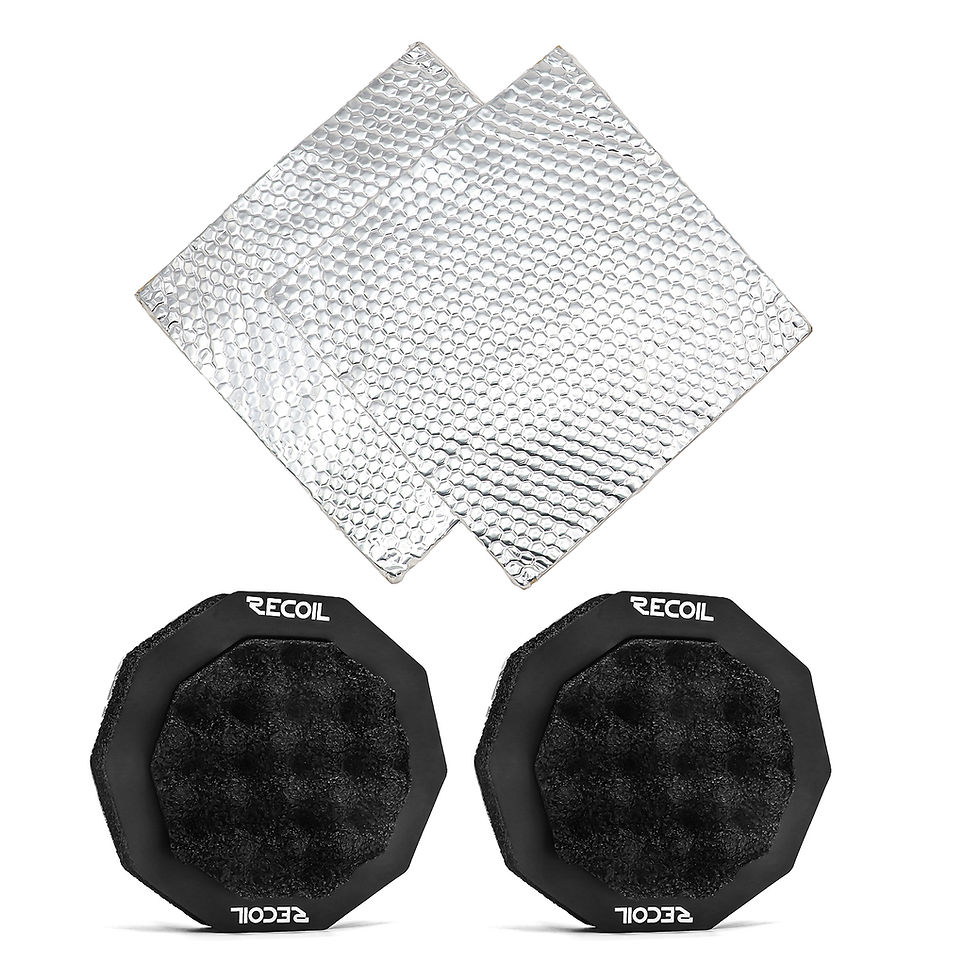
Measure the opening against the 184 mm diameter and check the depth behind it against 87 mm, with the window fully down in a door. If the opening is the wrong size, a baffle or pod adapts it; VA3 Car Studio in Ghaziabad builds custom speaker pods and door baffles, and offers professional installation. Damping the panel around it reduces rattles on rough roads, as our guide to applying sound damping in a car explains.
Price and where to buy
The Recoil MX8 carries an India MRP of ₹20,000 for the pair. VA3 Car Studio often sells below MRP, so check the current offer on the MX8 product page.

The bottom line
The Recoil MX8 is an 8-inch coaxial with a published crossover recommendation, published mounting dimensions and the same ₹20,000 MRP as the MX69. Its open question is whether 350 W RMS is per speaker or per pair. Settle that, plan an active crossover at 80 Hz and 12 dB per octave, and measure your opening before you order.
Recoil MX8 FAQ
What is the Recoil MX8's RMS power?
Our listing and Recoil's page both give 350 W RMS and 700 W peak, without saying whether that is per speaker or per pair. The 700 W figure is a peak rating, not RMS. Confirm the basis with Recoil or its distributor before sizing an amplifier.
What crossover does Recoil recommend for the MX8?
Recoil recommends an active crossover setting of 80 Hz to 20 kHz at 12 dB per octave. That is a high-pass at 80 Hz with no low-pass until 20 kHz, which needs a processor or electronic crossover.
What size opening does the Recoil MX8 need?
The listing and Recoil's page give a mounting diameter of 184 mm and a mounting depth of 87 mm. Measure your own opening and the space behind it before you order.
Does the MX8 have owner reviews?
None that we could find. Recoil's own page shows no reviews, and the retailer and forum pages we could read had nothing on it. Owners are welcome to share their experience in the comments.


Comments