ESB 3.10D4 Review: 10-Inch DVC Subwoofer with Kapton Voice Coil at ₹26,990

Updated: Jul 8
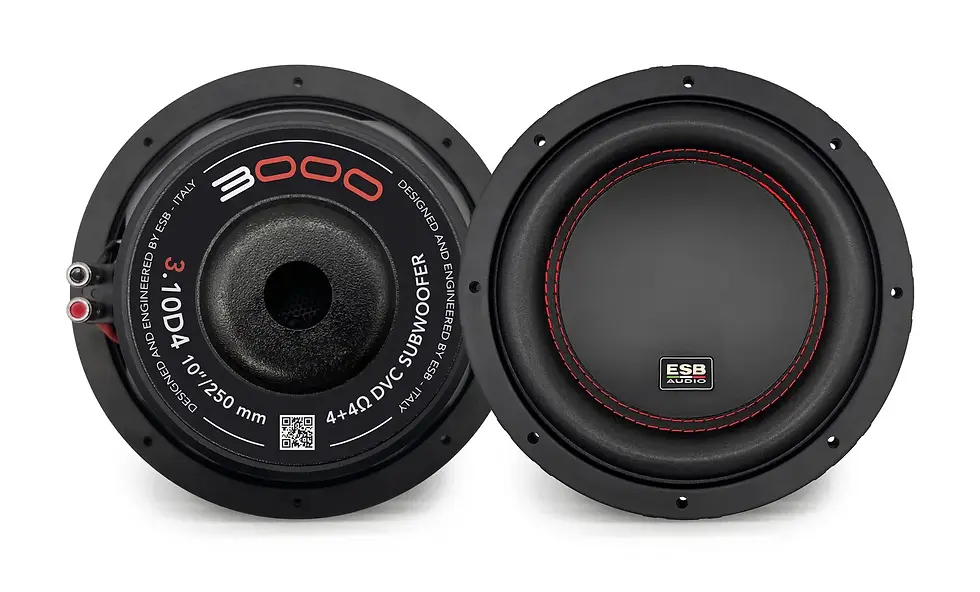
The ESB 3.10D4 is a 10-inch/250mm dual voice coil subwoofer from the ESB Tremila 3000 Series at ₹26,990 — the standard-depth SQ subwoofer in ESB's India range, built around a 4-layer voice coil with Kapton support, high-grade Y30 ferrite magnet, Conex spider, long-travel surround, and treated cellulose pulp cone. Rated at 300W RMS / 600W peak with 4+4Ω dual voice coils and 91 dB sensitivity, the ESB 3.10D4 is designed for buyers building dedicated enclosures: ESB specifies both a compact 16-liter sealed box and a 28-liter ported design, giving installers two engineered paths depending on available space and output goals.
Key Takeaways
₹26,990 — Tremila SQ subwoofer with materials borrowed from far more expensive drivers: Kapton, Conex, Y30 ferrite.
300W / 600W RMS / Peak, DVC 4+4Ω — wire to 2Ω or 8Ω, or drive each coil from its own amp channel.
Two ESB-specified enclosures: 16L sealed (tight spaces, accurate bass) or 28L ported (+3 dB output, same power).
91 dB sensitivity — satisfying output from modest mono amplifiers in the 250–350W class.
ESB 3.10D4 Full Specifications
Specification | Value |
|---|---|
Size | 10" / 250mm |
Type | Dual voice coil (DVC) |
Impedance | 4 + 4 Ω |
RMS / Peak power | 300W / 600W |
Sensitivity | 91 dB @ 2.83V / 1m |
Voice coil | 4-layer copper with Kapton support |
Magnet | High-grade Y30 ferrite |
Spider | Conex |
Surround | Long travel |
Cone | Treated cellulose pulp |
Basket | Steel, rigidity-optimized shape |
Sealed enclosure | 16 liters |
Ported enclosure | 28 liters (+3 dB output) |
MRP (India) | ₹26,990 |
The Kapton Voice Coil: Space-Grade Material in a ₹26,990 Sub
ESB builds the 3.10D4's voice coil on a Kapton former — a synthetic polyimide originally developed for outer space applications, chosen for two properties that matter enormously in a subwoofer. First, thermal stability: Kapton withstands very high temperatures without deforming. A subwoofer voice coil is the hottest component in any car audio system — sustained bass reproduction at 300W pushes coil temperatures toward levels where cheaper formers (paper, aluminum in budget implementations) warp, causing the coil to scrape the magnetic gap and eventually fail. Kapton simply does not deform at those temperatures. Second, very low mass: the former contributes nothing useful to sound, so every gram saved there improves transient response — the sub starts and stops faster.
The coil itself is wound with 4 layers of copper wire, providing what ESB describes as an extra-long stroke. More winding layers means more of the coil remains in the magnetic gap throughout the cone's travel — the motor keeps control of the cone even at high excursion, which is precisely when cheaper subs lose composure and bass turns from notes into noise.
Conex Spider and the Long-Game Engineering
The spider — the corrugated suspension ring centering the voice coil — is made of Conex, a semi-synthetic material ESB specifies for its constancy of elasticity over time. This addresses a failure mode buyers rarely consider at purchase: ordinary spider materials gradually soften over years of intense use, changing the sub's tuning parameters. A sub that measured perfectly in a 16L sealed box at installation slowly becomes a different driver as its suspension loosens. Conex maintains its mechanical properties, meaning the 3.10D4 in year six performs like the 3.10D4 on day one. Combined with the treated cellulose pulp cone — chosen for its damping properties that produce deep, detailed bass rather than one-note thump — the materials list reads like a driver twice this price.
The Motor: Low-Carbon Steel, CNC Plates, Eddy Current Control
Three motor details from ESB's Tremila subwoofer engineering apply here. The motor structure uses very low carbon steel for the highest magnetic permeability — more of the Y30 ferrite magnet's energy reaches the voice coil gap instead of leaking into the surrounding structure. The plates are CNC-machined to tight tolerances, keeping the magnetic gap consistent unit to unit. And the motor geometry is optimized to reduce eddy currents — parasitic electrical currents induced by the moving voice coil that act as an unwanted brake and distortion source. ESB states this dramatically decreases distortion; in listening terms, it is part of why the 3.10D4 renders bass lines with pitch definition rather than generic weight.
Sealed 16L or Ported 28L: Choosing Your Enclosure
ESB publishes two recommended enclosures, and the choice defines the sub's character. The 16-liter sealed box is remarkably compact for a 10-inch driver — external dimensions around 35 × 35 × 20 cm in 18mm MDF. Sealed alignment delivers the tightest transient response and the most accurate pitch tracking, with a gentle low-frequency roll-off that in-car cabin gain naturally compensates. This is the SQ choice and the space-constrained choice simultaneously.
The 28-liter ported box produces 3 dB more output with the same amplifier power — equivalent to doubling amp wattage for free, paid for in enclosure volume. Port tuning must be built precisely to ESB's datasheet specification; a mistuned port trades the 3.10D4's composure for boom. Choose ported if output priority outweighs boot space, sealed for everything else. Both are legitimate, engineered options — not compromises.
Wiring and Amplifier Pairing
The 4+4Ω dual voice coils wire three ways: parallel to 2Ω for maximum power extraction from a 2Ω-stable mono amp; series to 8Ω for high-impedance-preferring amplifiers; or independently, one coil per channel on a bridged 4-channel amp. The natural pairing is a mono block delivering 250–350W RMS into your chosen load. The 91 dB sensitivity means even a modest ₹12,000–18,000 Class D mono produces genuinely satisfying output. Add a subsonic filter at 25–30 Hz (especially in the ported box) and a low-pass around 80 Hz to blend with a Tremila front stage like the 3.6K2 or 3.6K3U. A DSP makes that integration precise — see our budget DSP guide.
3.10D4 vs 1.10SD4: Standard Depth vs Shallow
Buyers comparing this sub to the Mille 1.10SD4 shallow sub (₹22,990) should decide on installation space alone. The 3.10D4's standard-depth motor delivers more excursion capability, higher power handling (300W vs 250W RMS), and the superior Kapton/Conex/cellulose materials package — it is simply the better subwoofer when space allows a proper enclosure. The 1.10SD4 exists for the installs where 9.5 cm depth is the hard constraint. If your boot accepts a 16-liter box, buy the 3.10D4.
The Bottom Line
The ESB 3.10D4 is the SQ subwoofer of the Tremila 3000 Series and the honest sweet spot of ESB's bass range. Kapton voice coil support, Conex spider, treated cellulose cone, and an eddy-current-optimized motor deliver materials engineering normally found well above ₹26,990. Two factory-specified enclosures cover both compact and output-priority builds. For a Tremila front stage that deserves matching bass — controlled, pitched, durable — this is the correct driver.
Frequently Asked Questions
Which enclosure should I build for the ESB 3.10D4?
Sealed 16L if space is tight or SQ accuracy is the priority; ported 28L if you want 3 dB more output and have the boot space. Both are ESB-specified designs — follow the datasheet dimensions exactly, especially port tuning on the ported box.
What amplifier does the ESB 3.10D4 need?
A mono block delivering 250–350W RMS into 2Ω (coils parallel) is ideal. The 91 dB sensitivity means budget Class D monos work well. Use a subsonic filter at 25–30 Hz and low-pass around 80 Hz.
Is the ESB 3.10D4 good for SPL competition?
No — it is an SQ driver. Its strengths are pitch accuracy, transient control, and long-term durability, not maximum sound pressure. For loudness-first builds, look at dedicated SPL drivers; for musical bass, this is the right choice.

Comments