ESB 3.12D4 Review: 12-Inch DVC Subwoofer with 500W RMS at ₹29,990

Updated: Aug 21

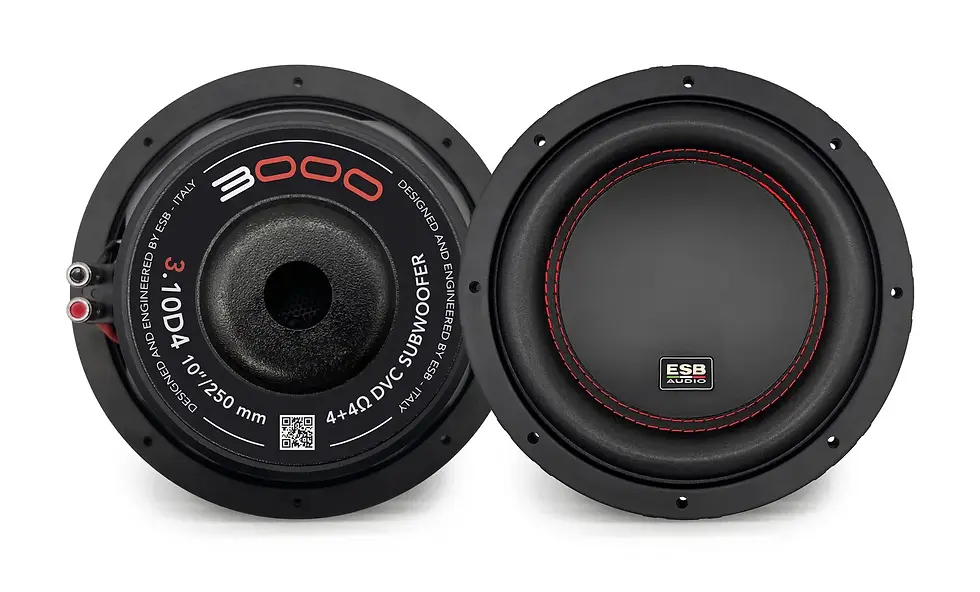
The ESB 3.12D4 is the 12-inch/300mm dual voice coil subwoofer from the ESB Tremila 3000 Series at ₹29,990 — the highest-output bass driver in ESB's mainstream India range. It shares the complete Tremila subwoofer materials package with its 10-inch sibling: 4-layer voice coil with Kapton support, high-grade Y30 ferrite magnet, Conex spider, long-travel surround, and treated cellulose pulp cone — but scales power handling to 500W RMS / 800W peak with the cone area advantage that only a 12-inch driver provides. For just ₹3,000 over the 3.10D4, the ESB 3.12D4 delivers roughly 44% more cone area and 67% more rated power handling, making it the output-per-rupee champion of the ESB subwoofer lineup.
Key Takeaways
₹29,990 — only ₹3,000 more than the 10-inch 3.10D4 for 44% more cone area and 500W RMS handling.
500W / 800W RMS / Peak, DVC 4+4Ω, 91 dB sensitivity — the loudest driver in ESB's mainstream range.
Same premium materials as the 3.10D4: Kapton voice coil support, Conex spider, treated cellulose cone.
Needs a larger enclosure than the 10-inch — buy this when boot space is available, not despite it.
ESB 3.12D4 Full Specifications
Specification | Value |
|---|---|
Size | 12" / 300mm |
Type | Dual voice coil (DVC) |
Impedance | 4 + 4 Ω |
RMS / Peak power | 500W / 800W |
Sensitivity | 91 dB @ 2.83V / 1m |
Voice coil | 4-layer copper with Kapton support |
Magnet | High-grade Y30 ferrite |
Spider | Conex |
Surround | Long travel |
Cone | Treated cellulose pulp |
Basket | Steel, rigidity-optimized shape |
MRP (India) | ₹29,990 |
Why Cone Area Is the Cheapest Output Upgrade in Bass
Bass output is fundamentally about moving air, and there are only two ways to move more of it: more cone excursion or more cone area. Excursion is expensive — it demands longer voice coils, taller magnetic gaps, and suspension engineering that keeps distortion controlled at extreme travel. Cone area is comparatively cheap: a 12-inch cone has roughly 44% more radiating surface than a 10-inch. At identical excursion, the 3.12D4 simply displaces 44% more air than the 3.10D4 — which translates directly to output, and equally importantly, to reduced excursion at any given volume level. A 12 playing at the same loudness as a 10 works measurably less hard, staying further inside its linear range where distortion is lowest.
This is why the ₹3,000 step from the 3.10D4 is such rational money. You are not paying for exotic upgrades — the materials package is identical. You are paying for physics: more cone, more motor, more power handling, and a sub that loafs where the 10-inch works.
The Shared Tremila Materials Package
Everything that makes the 3.10D4 a standout at its price applies here at larger scale. The Kapton voice coil former — a space-application polyimide — withstands the even greater heat a 500W coil generates without deforming, while its low mass keeps transients quick despite the heavier cone. The 4-layer copper winding provides the extra-long stroke that keeps the motor in control throughout the 12-inch cone's greater travel. The Conex spider maintains constant elasticity over years of hard use, so the sub's tuning does not drift as it ages. The treated cellulose pulp cone provides the internal damping that separates deep, detailed bass from undifferentiated boom. And the motor's low-carbon steel structure, CNC-machined plates, and eddy-current-optimized geometry carry over unchanged — ESB engineered one subwoofer platform and built it in two sizes.
500W RMS: What It Means in Practice
The 500W RMS rating changes the amplifier conversation versus the 10-inch. Where the 3.10D4 is happy on a 250–350W budget mono, the 3.12D4 rewards 400–500W of clean power — moving you into the mid-tier monoblock class. With coils wired parallel to 2Ω, most quality mono amps in the ₹18,000–30,000 range deliver this comfortably. That said, the 91 dB sensitivity means the 3.12D4 also performs well underpowered: on a 300W amp it will still outplay the 3.10D4 on the same amp, because the cone area advantage applies at every power level. Underpowering a sensitive sub is safe; the danger is clipped signal from an overdriven small amp, not clean moderate power.
Enclosure Considerations
A 12-inch driver needs proportionally more enclosure volume than a 10-inch — expect a sealed box in the 25–35 liter class and a ported design in the 45–60 liter class depending on target tuning (consult the ESB datasheet packed with the driver for exact recommended volumes). In practical Indian terms: the 3.12D4's sealed box occupies roughly a third of a midsize sedan boot; the ported box approaches half. This is the honest cost of the 12-inch output advantage. If those numbers do not fit your boot and cargo needs, the 3.10D4's 16-liter sealed box is the better-proportioned choice — a smaller sub in the right box beats a larger sub crammed into the wrong one.
Which Buyers Should Choose the 3.12D4
Bass-forward listeners. If your library leans toward hip-hop, EDM, Punjabi and Bollywood bass-heavy production, the 12's displacement advantage renders the low octave with authority a 10 approximates but cannot match.
Larger vehicles. SUVs and large sedans have both the boot volume for the enclosure and the cabin volume that benefits from greater displacement — a 10-inch sub that fills a Swift can feel modest in a Fortuner.
Headroom seekers. Running any driver at 60% of capability rather than 90% yields cleaner output and longer life. The 3.12D4 loafing beats the 3.10D4 laboring at identical volume levels.
Pair it with a Tremila front stage — 3.6K2 or 3.6K3U — crossed at 80 Hz, with a DSP handling integration (see our Onkyo R-MS66 guide), and the result is a full-range all-ESB system with genuinely effortless bass foundation.
The Bottom Line
The ESB 3.12D4 is the output flagship of ESB's mainstream subwoofer range and the best displacement-per-rupee purchase in the catalog. Identical premium materials to the 10-inch — Kapton, Conex, treated cellulose — scaled to 500W RMS and 44% more cone area for ₹3,000 more. If your boot accommodates the enclosure, this is the Tremila bass driver to buy; the only honest reason to choose the smaller sub is space.
Frequently Asked Questions
ESB 3.12D4 or 3.10D4 — which should I buy?
Buy the 3.12D4 if your boot fits its larger enclosure — the extra ₹3,000 buys 44% more cone area and 67% more power handling with identical materials. Buy the 3.10D4 only when space constrains you to its compact 16-liter sealed box.
What amplifier suits the ESB 3.12D4?
A mono block delivering 400–500W RMS into 2Ω (coils parallel) is the ideal match. It performs well on less — 300W of clean power still sounds excellent — but avoid small amps driven into clipping, which damages subs faster than honest high power.
Is the 3.12D4 too much bass for a hatchback?
Not too much bass — possibly too much enclosure. Small cabins reach satisfying levels easily with either sub; the question is whether the hatch boot fits the 12's box while remaining usable. Measure before deciding; many hatchback owners are happier with the 3.10D4 sealed.
Comments