ESB 3.6K2 CX Review: 2-Way Passive Crossover with 4-Step Tweeter Adjustment at ₹10,990

Updated: Jul 8
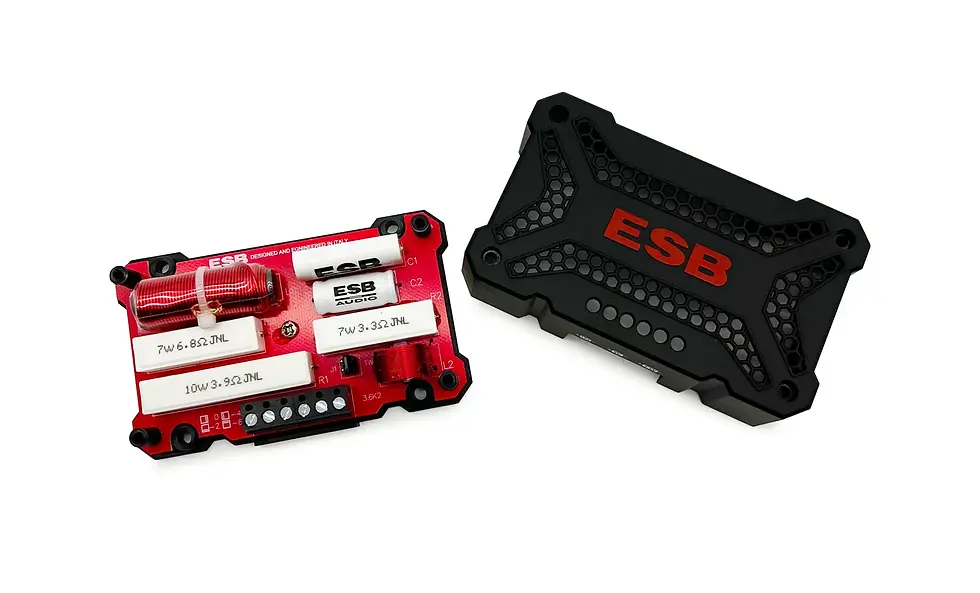
The ESB 3.6K2 CX is the dedicated 2-way passive crossover for the ESB Tremila 3000 Series at ₹10,990 — the component that completes the 3.6K2 speaker system for buyers running passive rather than active configurations. Built with oversized ceramic resistors, a polyester capacitor in the tweeter path, and a 4-step tweeter level adjustment, the ESB 3.6K2 CX is a rare product in Indian car audio: a passive crossover engineered and sold as a serious component in its own right, rather than a cost-reduced afterthought bundled in a speaker box. That positioning tells you how ESB thinks about the passive signal path — and why this network deserves its own review.
Key Takeaways
₹10,990 per pair — the dedicated passive network for the Tremila 3.6K2 2-way system.
4-step tweeter level adjustment — tune high-frequency output to your specific cabin acoustics at install time.
Oversized ceramic resistors — thermal headroom that keeps the attenuation stable under sustained high power.
Polyester tweeter capacitor — a film capacitor in the most sonically sensitive position of the network.
ESB 3.6K2 CX Specifications
Specification | Value |
|---|---|
Type | 2-way passive crossover |
Designed for | ESB 3.6K2 (3.28 tweeter + 3.165 woofer) |
Resistors | Oversized ceramic |
Tweeter capacitor | Polyester film |
Tweeter level | 4-step adjustment |
MRP (India) | ₹10,990 |
What a Passive Crossover Actually Does — and Why Quality Varies
A passive crossover sits between your amplifier and your speakers, splitting the full-range signal so the woofer receives only low and mid frequencies while the tweeter receives only highs. Every component set needs this filtering; the question is how well it is executed. The crossover is the last electronic component your music passes through before becoming sound, and its parts quality directly shapes what you hear. Cheap crossovers use undersized resistors that drift as they heat, electrolytic capacitors that degrade and add distortion, and thin-gauge inductors that compress dynamics. The signal that reaches your carefully chosen drivers has already been compromised.
ESB sells the 3.6K2 CX separately at ₹10,990 — roughly a third of the 3.6K2 speaker price — because building it properly costs real money, and bundling a proper network would force active-configuration buyers to pay for components they discard. The unbundled model is more honest than the industry norm of including a cost-reduced network and calling the system complete.
The Component Choices, Decoded
Oversized ceramic resistors. Resistors in a crossover attenuate the tweeter to match the woofer's sensitivity, converting excess electrical energy to heat. An undersized resistor heats up under sustained volume, and a hot resistor changes value — meaning the tweeter level drifts audibly during the loud passages where you most want stability. ESB's oversized ceramic units run cooler at any given power, keeping attenuation constant from quiet listening to full output. This is unglamorous engineering that shows up as consistency rather than a feature you can demo in a shop.
Polyester tweeter capacitor. The series capacitor in the tweeter path is the single most sonically influential component in a 2-way network — every high frequency you hear passes through it. Electrolytic capacitors, the budget norm, exhibit higher distortion and degrade measurably within a few years in automotive heat. Polyester film capacitors are stable, low-distortion, and effectively permanent. ESB's choice here is the difference between a tweeter that sounds the same in year eight and one that has slowly gone brittle.
4-step tweeter level adjustment. Every car cabin treats high frequencies differently. Large windshields and panoramic glass reflect treble energy toward the listener; fabric seats and soft dashboards absorb it. A tweeter voiced flat in one cabin sounds bright in another and dull in a third. The 3.6K2 CX's four-position level switch lets the installer match tweeter output to the actual acoustic environment — typically spanning around -3 dB to +3 dB in steps — without touching amplifier gains or requiring DSP. During installation tuning, this adjustment is used constantly; its absence on budget crossovers forces compromises that no driver quality can recover.
Who Should Buy the 3.6K2 CX — and Who Should Not
Buy it if you are running the 3.6K2 system passively: one stereo amplifier pair driving the complete front stage through this network. Total system cost lands at ₹40,980 (speakers plus crossover), and the result is an excellently engineered passive front stage with real installation-tuning flexibility. This is the right path for buyers who want simplicity — fewer amp channels, no DSP configuration, no tuning software.
Skip it if you are running active. A DSP with four output channels replaces this network entirely and adds per-driver time alignment the passive path cannot offer. Put the ₹10,990 toward the processor instead — see our Onkyo R-MS66 DSP review for the budget entry. ESB's crossover-optional system design exists precisely so active builders never pay for passive parts.
The HE variant note: ESB also lists an HE (high efficiency) version of the Tremila CX networks for lower-power amplifier configurations. If your amplifier delivers under roughly 60W per channel, ask your dealer about the HE variant; it preserves system efficiency where the standard network assumes power headroom.
Installation Notes
The crossover pair mounts inside the doors near the woofers or behind the kick panels — anywhere protected from water ingress and physical impact. Keep signal wiring away from power cable runs to avoid induced noise. Set the tweeter level switch during final tuning, with music you know well, after the amplifier gains are set: start at 0 dB, and adjust one step at a time while listening from the driver's seat. In glass-heavy cabins (sunroof, large greenhouse), expect to land at -3 dB; in absorptive interiors, 0 or +3 dB.
The Bottom Line
The ESB 3.6K2 CX is what a passive crossover looks like when a manufacturer treats it as a component rather than packaging. Oversized ceramic resistors for thermal stability, a polyester film capacitor in the position that matters most, and 4-step tweeter adjustment that makes real-world installation tuning possible. At ₹10,990 it completes the Tremila 3.6K2 passive signal path at a quality level matching the drivers it serves. Passive builders should consider it essential; active builders should skip it with a clear conscience — exactly as ESB designed.
Frequently Asked Questions
Does the ESB 3.6K2 CX work with non-ESB speakers?
It is engineered specifically for the 3.28 tweeter and 3.165 woofer's impedance and sensitivity characteristics. It will function with other 4-ohm 2-way sets, but the crossover points and attenuation are optimized for the 3.6K2 — pairing it with other drivers gives unpredictable results.
Is the 3.6K2 CX included with the 3.6K2 speakers?
No. The 3.6K2 system (₹29,990) ships without a crossover so active-configuration buyers do not pay for parts they will not use. Add the CX at ₹10,990 for passive installs.
Passive with the CX or active with a DSP — which sounds better?
A well-tuned active setup wins on imaging thanks to time alignment. A passive setup through the 3.6K2 CX wins on simplicity and total cost if you do not already own a DSP. Both paths deliver the Tremila drivers' quality; the choice is about your appetite for tuning complexity.

Comments