Tchernov Standard 2.0 Speaker Wire Review: 2.0 mm² for Amplified Car Systems

Updated: Oct 6
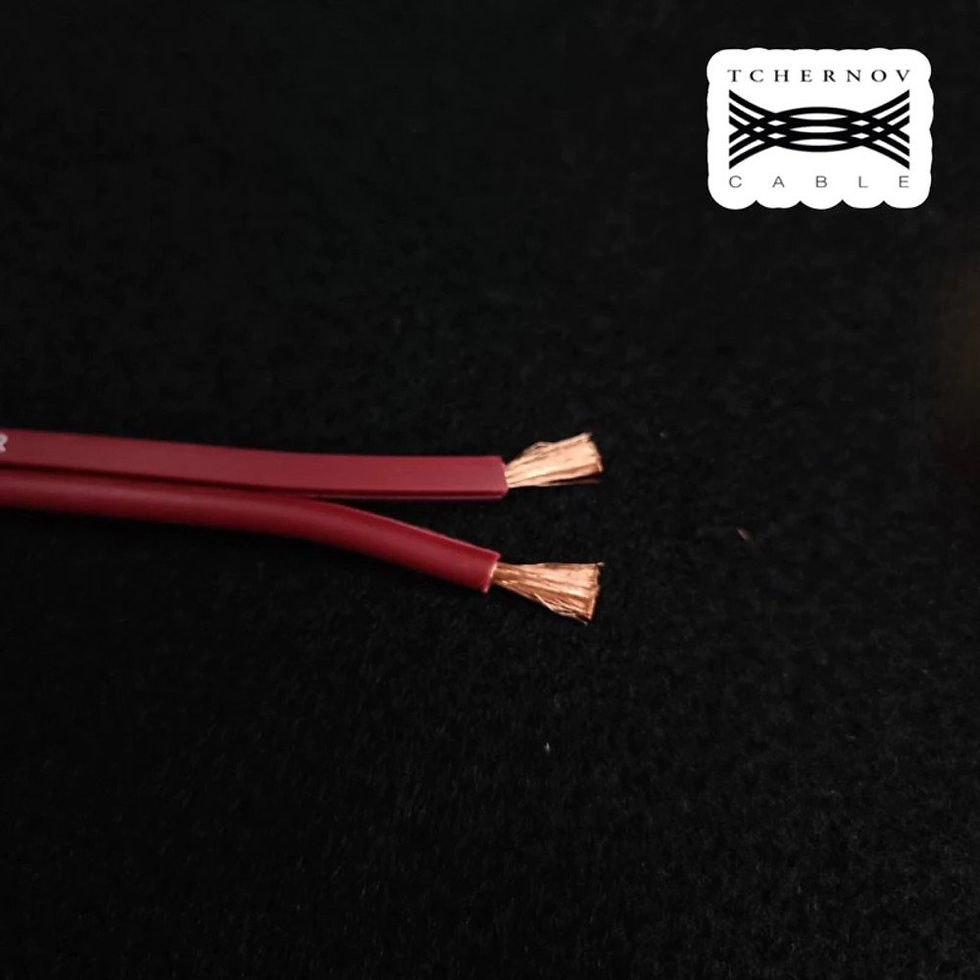
The Tchernov Standard 2.0 speaker wire is the heavier of Tchernov's two Standard-series speaker cables: a parallel pair of 2.0 mm² conductors (Tchernov labels them 15 AWG, though 2.0 mm² is closer to 14 AWG on the standard table), each made of 80 strands of 0.18 mm, in low-loss SPVC insulation measuring 4 x 8 mm. Its 2026 Indian MRP is ₹1,69,990, which our store lists for a 180 m spool, roughly ₹944 a metre. Tchernov pitches it for amplifier-to-speaker runs, and the numbers bear that out: it keeps losses negligible on 2 Ω loads, active front stages and most subwoofer runs. The spool is on our Tchernov Standard 2.0 speaker wire product page.

Main points
Twice the copper of the Standard 1.0, so half the resistance: about 0.07 Ω for a 4 m door run, against roughly 0.14 Ω with the slimmer wire.
Suited to amplified systems, including 2 Ω loads and subwoofers on moderate power; overkill for coaxials on head-unit power.
The 4 x 8 mm profile routes neatly along sills and in conduit, but it's a tighter squeeze through door grommets than the 3 x 6 mm Standard 1.0.
No owner or press reviews were found as of October 2026, so this assessment rests on the specifications and basic electrical arithmetic.
Tchernov Standard 2.0 speaker wire specifications
Specification | Standard 2.0 Speaker Wire |
|---|---|
Type | Speaker wire, parallel conductor layout |
Conductors | 2 x 2.0 mm² (labelled 15 AWG by Tchernov), 80 x 0.18 mm multi-stranded BRC copper |
Insulation | Low-loss SPVC with antistatic treatment |
Outer dimensions | 4 x 8 mm |
Supply | On spools; catalogue lists 180 m and 1.00 m lengths |
Country of origin | Russia |
India MRP | ₹1,69,990 (listed by our store for the 180 m spool) |
Specifications come from the 2026 Indian catalogue and Tchernov Cable's official Standard 2.0 speaker wire page. The catalogue doesn't state which length its MRP covers, and neither the catalogue nor our listing gives a resistance figure, so the calculations below use standard values for copper.
Twice the copper of the Standard 1.0
The construction mirrors the Standard 1.0, scaled up. Each conductor doubles the strand count to 80, giving 2.0 mm², and the two run side by side in the same low-loss, antistatic SPVC, which splits easily at the ends. The extra copper adds a millimetre in thickness and two in width.
Tchernov describes it as a wire for unstressed amplifier-to-speaker pairing with no limit on dynamics, says it lays neatly in trunking and cable-management systems, and promises a full-bodied sound. The routing point is practical and true of any flat pair this size; the sound claims are marketing.
Sizing it for amplifiers and subwoofers
Copper of 2.0 mm² measures about 0.0086 Ω per metre per conductor. A 4 m run to a front door therefore adds roughly 0.07 Ω: on a 4 Ω speaker that's a level loss of about 0.15 dB, and on a 2 Ω load about 0.3 dB. By the common guideline of keeping wire resistance under 5% of the load, this wire allows runs of nearly 12 m at 4 Ω and nearly 6 m at 2 Ω, longer than any run in a typical Indian car.
Current handling is comfortable too. A Zapco REF 150.4 channel delivering its rated 230 W into 2 Ω pushes about 10.7 A RMS, and the amplifier's bridged 470 W into 4 Ω works out to a similar figure. Over the short run from a boot-mounted amplifier to a subwoofer, 2.0 mm² handles that with almost no loss. JL's VX600/6i, at 100 W per channel into 2 Ω, asks even less.
For the largest subwoofer amplifiers, delivering a kilowatt or more into low impedances, heavier wire is the safer choice, and the amplifier's own power feed matters more than the speaker wire; our Tchernov 4 AWG power cable post covers that side.
What a thicker wire does, and the claims it can't back
Going from 1.0 to 2.0 mm² halves resistance, which matters most at low impedances and high currents: less power turned into heat in the wire, and slightly better control of the woofer by the amplifier. Those are real, measurable gains, but small ones, typically a few tenths of a decibel at car lengths. Inductance and capacitance over these distances are negligible either way.
A thicker wire can't add bass a speaker or enclosure doesn't produce, so treat full-bodied sound as Tchernov's description rather than a promise. The same goes for its advice to allow 100 hours of uninterrupted playback for burn-in, which we're not aware of any measurement supporting.
What owners and reviewers say about the Tchernov Standard 2.0 speaker wire
When we checked in October 2026, we found no owner reviews or press tests that we could verify for this wire. A DIYMobileAudio discussion of Tchernov speaker wire exists on the car-audio forum, but the page wouldn't open for us, so we can't say which Tchernov wire it covers or what anyone concluded.
Without independent reports, the verifiable picture is the construction and the arithmetic above, plus Tchernov's claims, which we've labelled as such. Owners who have run the Standard 2.0 in a car are welcome to share their experience with us.
How it compares with Tchernov's other speaker wires
The Standard 1.0 speaker wire has half the copper in a slimmer 3 x 6 mm profile, on a 280 m spool at ₹1,44,990, about ₹518 per metre. It's the better choice for door speakers on modest power, mainly because it's easier to route. The Special 2.5 speaker wire adds a little more copper (2.5 mm²) with foamed-polyethylene insulation under a damped SPVC jacket, 5 x 12 mm, at ₹1,29,990 for 95 m, which is about ₹1,368 per metre.
The Supreme MK2 speaker wire in 14 gauge, roughly 2.1 mm² if the gauge follows AWG, offers similar copper on a 100 m spool at ₹74,990. It isn't listed on Tchernov's official website, though, and its catalogue specifications aren't tied to a particular gauge.
Who it suits, and who can use something slimmer
It suits amplified systems: active or bi-amped front stages, 2 Ω loads, rear fill and subwoofers on moderate power, especially where runs go from a boot-mounted amplifier to the front doors. Installers who keep a reel for several cars will get the most from the 180 m spool.
Use something slimmer if you're fitting coaxials on head-unit power, where the Standard 1.0 does the job and routes more easily. And if you need wire for only one car, a 180 m spool is a lot to buy; ask us about shorter quantities first.
Installation notes for Indian cars
Plan the run before you pull trim. The 4 x 8 mm pair lays neatly along the sill channels and through conduit, but the rubber boot between body and door is often tight, so check the grommet before committing; some installers use split loom here to protect the jacket at the hinge. Leave a service loop at each end and secure the wire away from seat runners and the spare-wheel well, where vibration on rough roads can chafe it.
Boot floors can get hot in summer, so keep the wire off any panel that sits above the exhaust. At the terminals, use crimped ferrules or ring terminals with heat-shrink, since bare copper tarnishes quickly in humid weather, and confirm polarity at both ends. VA3 Car Studio in Ghaziabad can plan the speaker wiring as part of an amplifier installation.
Price and where to buy
The 2026 Indian catalogue lists the Standard 2.0 speaker wire at ₹1,69,990, and our store lists it as a 180 m spool, about ₹944 per metre. VA3 Car Studio often sells below MRP, and every spool we sell is a genuine Tchernov Cable product, made in Russia. The catalogue also mentions a 1.00 m length without giving its price, so ask us about smaller quantities. You'll find today's price on the Standard 2.0 180 m spool page.
The bottom line
The Standard 2.0 is the sensible all-rounder for amplified car systems: enough copper to make losses negligible on 2 Ω loads and most subwoofer runs, in a flat profile that lays neatly. It won't change your speakers' character, whatever the marketing says, and it isn't the easiest wire to thread through a tight door boot. We found no independent reviews, so choose it on gauge and construction, which suit the job on paper.
Tchernov Standard 2.0 speaker wire FAQ
Is the Tchernov Standard 2.0 speaker wire good enough for a subwoofer?
For most subwoofer amplifiers, yes. A 1.5 m boot run adds only about 0.03 Ω, and even 230 W into 2 Ω means roughly 10.7 A, well within 2.0 mm² copper. For very large monoblock amplifiers, heavier wire is the safer choice.
Should I use the 1.0 or the 2.0 for my door speakers?
On head-unit power or a modest amplifier into 4 Ω, the slimmer 1.0 is enough and easier to route through door grommets. Choose the 2.0 for 2 Ω loads, higher-power amplifiers or long runs where you want losses below about 0.2 dB.
How much speaker wire does a car need?
It depends on the layout, but a four-speaker system with a boot-mounted amplifier typically needs roughly 15 to 25 m, far less than a 180 m spool. Ask us what we can supply for a single installation.
Buy the Tchernov Standard 2.0 Speaker Wire in India
You can buy the Tchernov Standard 2.0 Speaker Wire online from VA3 Car Studio with pan-India shipping. See more Tchernov cables, compare other car audio wiring and cables, or book car audio wiring and installation in Ghaziabad.


Comments