Tchernov Special 2.5 Speaker Wire Review: 2.5 mm² for Subwoofer and Crossover Runs

Updated: Oct 6
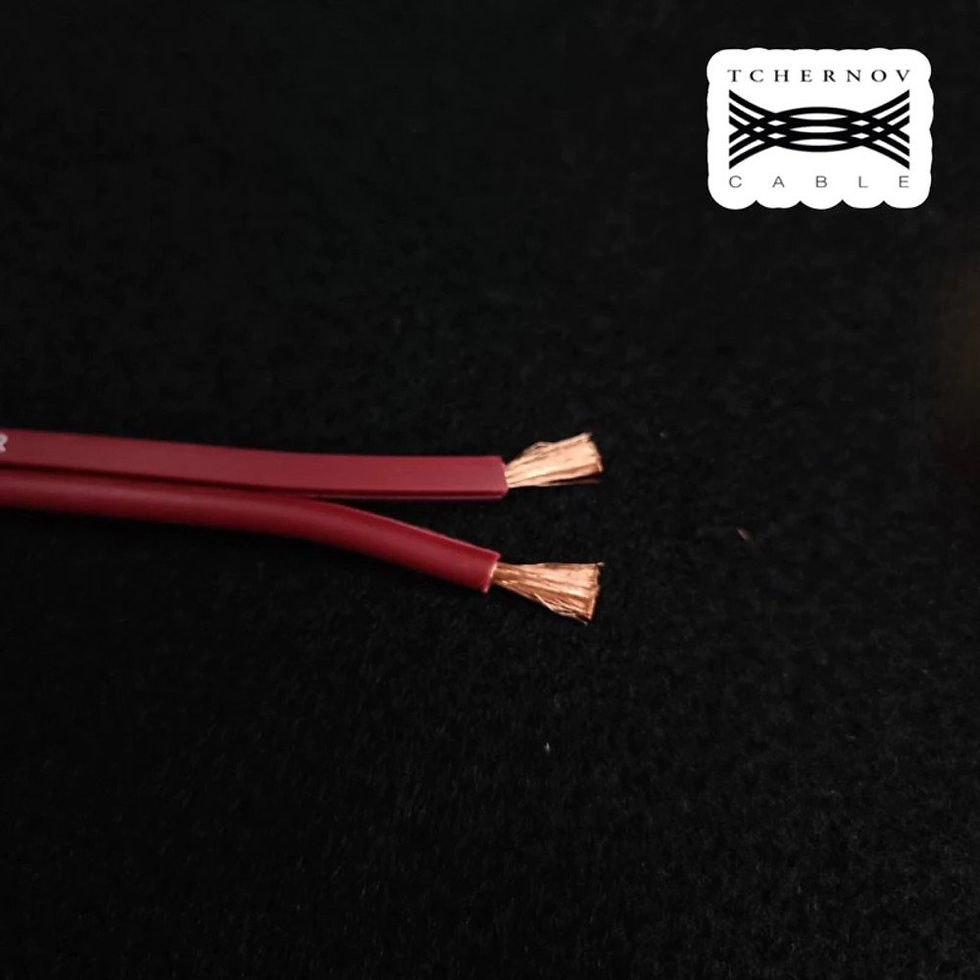
The Tchernov Special 2.5 speaker wire is the one Special-series speaker cable in Tchernov's 2026 Indian catalogue: two 2.50 mm² conductors of 98 fine BRC copper strands each, foamed-polyethylene insulation and a damped SPVC jacket measuring 5 x 12 mm. Its MRP is ₹1,29,990 for a 95 m bulk spool, about ₹1,368 a metre, the highest per-metre price of the four Tchernov speaker wires in our store listings, even though the spool costs less than either Standard reel. In a car, it makes most sense for subwoofer runs, high-power woofer channels and passive crossover leads. The spool is on our Tchernov Special 2.5 speaker wire product page.

The essentials
Each conductor's 98 strands give 2.50 mm², a quarter more copper than the Standard 2.0.
The real upgrade is the build: two-layer insulation with a foamed-PE inner layer, an integral separating cord and a separate vibration-damping jacket.
A 4 m run adds about 0.055 Ω; the insulation and jacket add mechanical protection on paper, not anything you'd hear.
No owner reviews or press tests turned up by October 2026, so the sound claims are Tchernov's alone.
Tchernov Special 2.5 speaker wire specifications
Specification | Special 2.5 Speaker Wire |
|---|---|
Type | Speaker wire, parallel conductor arrangement |
Conductors | 2 x 2.50 mm², 98 x 0.18 mm multi-stranded BRC copper (14 AWG per Tchernov) |
Insulation | Two-layer CAFPE® with an extended inner air-foamed PE layer |
Jacket | SPVC with high mechanical damping (catalogue: high mechanical decrement) |
Conductor separation | Integral separating cord (per our store listing) |
Outer dimensions | 5 x 12 mm |
Supply | 95 m bulk spool |
Country of origin | Russia |
India MRP | ₹1,29,990 (95 m bulk) |
Specifications come from the 2026 Indian catalogue, our store listing and Tchernov Cable's official Special 2.5 speaker wire page. Unlike the Standard wires, its MRP is clearly tied to a length, the 95 m bulk spool. Tchernov calls the conductors 14 AWG, though 2.5 mm² sits between 14 and 13 AWG. No resistance, capacitance or current rating is published, so the electrical figures below use textbook values for copper.
Built differently from the Standard pair
The Standard 1.0 and 2.0 are zip-cord style pairs: each conductor's low-loss SPVC insulation also forms the outside of the cable. The Special 2.5 is built in layers. Each conductor gets two layers of CAFPE® insulation, the inner one air-foamed polyethylene, and the insulated pair runs inside its own SPVC jacket, specified for high mechanical decrement, so vibration dies away in it quickly.
Our listing adds an integral separating cord to make the conductors easier to manage, and the finished cable is half as wide again as the Standard 2.0. The copper step is modest by comparison: 98 strands against 80. Tchernov promises more definition and immediacy across a wider frequency range; that's marketing, and we found nothing independent that tests it.
Foamed insulation and damping: the physics at speaker level
Foamed polyethylene has a lower dielectric constant than PVC, so it cuts the capacitance between the conductors. That's valuable in radio-frequency and digital cables. A speaker cable is the opposite case: a few metres long, driven from a very low output impedance into 2 to 8 Ω, where any ordinary cable's capacitance is far too small to touch the audio band.
Jacket damping follows the same logic. Cable-borne mechanical noise matters in very low-level circuits such as a turntable cartridge, but a speaker signal of several volts into a few ohms swamps it. In a car, any gain is mechanical: a separate damped jacket adds a layer against chafing and should, on paper, be less likely to tap against trim on rough roads.
The copper is what changes the numbers. At roughly 0.0069 Ω per metre per conductor, a typical 4 m amplifier-to-door run adds about 0.055 Ω, a loss of about 0.12 dB into 4 Ω or 0.24 dB into 2 Ω. The Standard 2.0 adds around 0.07 Ω over the same run, a difference of little more than a hundredth of an ohm.
Where it earns its place: subwoofers and crossover leads
Extra copper matters most where current is high and impedance low, which in a car means the subwoofer. JL's RD1000/1, rated at 1,000 W into 2 Ω, drives about 22 A RMS on a test tone; over a 1.5 m boot run, this wire adds roughly 0.02 Ω, about 1% of the load, so around 10 W becomes heat in the cable.
At 1 Ω the margin narrows. Zapco's ST-1000XM III, rated at 1,000 W into 1 Ω, pulls about 32 A on a test tone, and the same run costs around 2% of the power. Music averages far less, so a short run is fine, but keep the amplifier close to the enclosure and choose heavier cable for long runs.
Tchernov also suggests it for wiring inside speakers and crossovers. In a car, that means leads from a passive crossover to its woofer, or from an enclosure's terminal cup to the subwoofer. At 12 mm wide it's bulky inside a door, and tweeter leads carry so little current that slimmer wire is fine. The same applies in active systems built around a processor such as the JL Audio TwK88 or Zapco HDSP-Z16 V AD-16A: Special 2.5 for woofers and subwoofers, something lighter for tweeters, and, if you want to stay in one series, the Tchernov Special Balanced IC for signal links into balanced inputs.
What owners and reviewers say about the Tchernov Special 2.5 speaker wire
We found no independent feedback on the Special 2.5: our October 2026 search turned up no owner reviews or press tests, and no forum discussion we could read. A DIYMobileAudio forum thread on Tchernov speaker wire does exist, but it is about Tchernov speaker wire in general and was blocked when we tried to open it, so we can't say which models it covers or what members concluded.
Tchernov's own account is promotional: more definition and immediacy across a wider frequency range, plus a suggested burn-in of at least 100 hours of uninterrupted playback. No measurement we know of supports burn-in for copper cable. If you've used it in a car, we'd like to hear how it went.
Special 2.5 vs Standard 2.0, Standard 1.0 and Supreme MK2
Next to the Standard 2.0 speaker wire, the Special 2.5 adds a quarter more copper, foamed-PE insulation, the damped jacket and 4 mm of width. It costs about ₹1,368 a metre against roughly ₹944 for the 180 m spool our store lists for the Standard 2.0, but the 95 m spool means a smaller outlay: ₹1,29,990 against ₹1,69,990. The slimmer Standard 1.0 speaker wire, 1.0 mm² in a 3 x 6 mm pair, is the better tool for door speakers on modest power.
The Supreme MK2 speaker wire tops the ladder by name and is alone among the four in stating a copper purity, 99.99% OFC. It's sold by gauge, 18, 16 or 14, on 100 m spools costing ₹34,990 to ₹74,990, so even the 14-gauge version, about 2.1 mm² if that's AWG, comes to roughly ₹750 a metre. Tchernov's own website has no page for it, however, and the catalogue gives one set of figures for all three gauges.
Good fits and poor fits
Choose the Special 2.5 if you're wiring a subwoofer or high-power woofer channel, want a separately jacketed cable for boot and under-floor runs, or are rewiring a passive crossover with room to spare.
Spend less if the job is tweeters, coaxials on head-unit power or doors with tight grommets; the Standard 1.0 or an 18-gauge Supreme MK2 covers those for far less per metre. And since 95 m is several times what one car needs, talk to us before buying a whole spool.
Routing a 12 mm cable in Indian cars
At 5 x 12 mm, this cable may be a tight squeeze, or may not fit, through the rubber gaiter that carries wiring into the door in some hatchbacks and compact SUVs, so use it along the sills, under the floor and in the boot, with slimmer wire for door runs. Lay it flat under the carpet, away from seat-rail bolts, and grommet every pass through sheet metal.
Heat and humidity are hard on any cable in an Indian car: boot floors above the exhaust get hot in summer, and bare copper strands dull quickly in monsoon air, so crimp ferrules or ring terminals and seal them with heat-shrink. Secure the cable at short intervals so rough roads can't saw it against panel edges. VA3 Car Studio in Ghaziabad installs amplifier and subwoofer systems, wiring included.
Price and where to buy
The 2026 Indian catalogue lists the Special 2.5 speaker wire at ₹1,29,990 for a 95 m bulk spool, the only length it prices. VA3 Car Studio often sells below MRP; see the current offer on the Special 2.5 95 m spool page. The spool is genuine Tchernov Cable stock, made in Russia and distributed in India by Supreme Audiotek.
Our verdict
The Special 2.5 is a more elaborately built cable whose 2.5 mm² of copper suits subwoofers and high-power woofer runs. Most of its premium over the Standard 2.0 buys construction rather than electrical gains you could hear in a car. Use it where a heavier, jacketed cable helps, keep slimmer wire for doors and tweeters, and judge the sound claims for yourself.
Tchernov Special 2.5 speaker wire FAQ
Is the Tchernov Special 2.5 speaker wire thick enough for a subwoofer?
For most car subwoofer amplifiers, yes. Even with a 1,000 W monoblock into 2 Ω, a 1.5 m run adds only about 0.02 Ω, around 1% of the load. At 1 Ω and full power, keep the run as short as you can.
Is it 14 AWG or 13 AWG?
Tchernov describes it as 14 AWG, but 2.50 mm² falls between 14 AWG (about 2.08 mm²) and 13 AWG (about 2.63 mm²), nearer the latter. Either way, it has a quarter more copper than the Standard 2.0.
Will the foamed insulation make my system sound better?
Not by any mechanism we know of that applies to speaker cables over car lengths. Foamed polyethylene lowers capacitance, which matters for radio-frequency and digital signals; in a car, the benefits that follow from this wire's specification are its extra copper and separate jacket.
Buy the Tchernov Special 2.5 Speaker Wire in India
Check the Tchernov Special 2.5 Speaker Wire price in India, browse more Tchernov cables or compare all car audio wiring and cables in India. Want it fitted properly? Book car audio wiring and installation at our Ghaziabad studio.


Comments