Zapco Z-CB100F Review: 100 Farad Capacitor Bank With Amp Monitoring

Updated: Oct 6
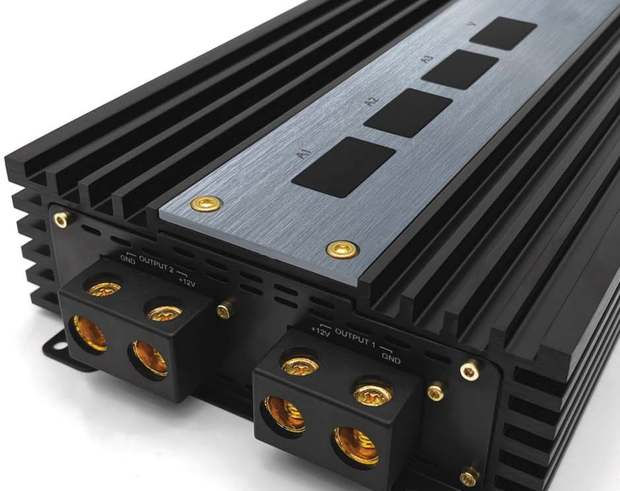
The Zapco Z-CB100F is a 100-farad supercapacitor bank with a gold top plate, which Zapco lists as the capacitor bank for its Z-AP amplifier series. Six 600 F supercapacitors in series give it 100 F with an internal resistance of just 0.0015 Ω, and four digital readouts show the current drawn by up to three amplifiers plus the system voltage. Its MRP in the 2026 Indian catalogue is ₹79,990, the costlier of the two Zapco capacitor banks we list and roughly three times the price of the 20 F HB CB20F. It suits multi-amplifier systems, especially current-hungry Class AB builds, in cars whose charging system is already in good health. The listing is on our Z-CB100F super capacitor bank page.

At a glance
100 F from six 600 F cells in series, with 0.0015 Ω internal resistance: a large, fast reservoir for the short current bursts of bass notes.
Four readouts show current for up to three amplifiers (A1 to A3) and voltage, which makes diagnosing voltage sag far easier.
It stores under one watt-hour of usable energy, so it can't stand in for a healthy battery and alternator.
We found no independent owner reviews; Zapco's own claims are the only performance statements on record.
Zapco Z-CB100F specifications
Specification | Zapco Z-CB100F |
|---|---|
Type | Super capacitor bank, gold top plate, for the Z-AP series |
Capacitance | 100 F (six 600 F supercapacitors in series) |
Working voltage | 12 V DC |
Peak voltage | 16 V DC |
Internal resistance (ESR) | 0.0015 Ω (at 120 Hz, 25 °C) |
Displays | Four: current for amplifiers 1 to 3 (A1, A2, A3) and voltage (V) |
Outputs | Three, for three or more amplifiers (owner's manual) |
Dimensions (L x W x H) | 320 x 190 x 62 mm |
Weight | 5.1 kg |
India MRP | ₹79,990 |
Figures come from Zapco's Z-CB100F product page and owner's manual, our store listing and the 2026 Indian catalogue, which prints no specification table for this model. None of these sources gives a standby current for the displays or a recommended fuse rating.
What a 100-farad bank actually does
Think of a capacitor bank as a reservoir parked beside the amplifiers. When a bass note demands a sudden burst of current, the bank supplies much of it through its very low internal resistance, so the voltage at the amplifier terminals dips less than it would if every amp of that burst had to come from the battery through several metres of cable. Between notes, it refills from the same battery and alternator.
Supercapacitor cells tolerate only a few volts each, which is why Zapco stacks six in series for a 12 V system. Series connection divides capacitance by the number of cells, so six 600 F cells make 100 F, and that's still a very large figure. If the bank alone supplied an extra 100 A for 20 milliseconds, its own voltage would fall by only about 0.02 V, plus roughly 0.15 V across its internal resistance. Short transients such as kick drums are the kind of demand it can help with.
What it can't do
A capacitor stores very little energy compared with a battery. Between 14.4 V and 12 V, 100 F gives up roughly 3,200 joules, under one watt-hour, while a 45 Ah battery of the kind fitted to many hatchbacks holds around 540 Wh. The bank smooths peaks, but it can't sustain a long, loud bass passage by itself, and it adds no charging capacity.
That matters most in Indian traffic. At idle with the AC running, many alternators can't cover the car's own loads plus a large Class AB system, so the battery makes up the difference and voltage slides, and the bank slides with it. The fixes there are a healthier or second battery, a higher-output alternator, the Big 3 and a properly sized main feed such as the Tchernov 0 AWG power cable. The capacitor is the finishing touch, not the foundation.
Reading the four displays
The readouts are the most practical part of the package. A1, A2 and A3 show the current each of up to three amplifiers is drawing, and V shows voltage, all live. Instead of guessing why the headlamps dim at a signal, you can watch the numbers: if voltage falls toward 12 V at idle with the AC on and recovers as the revs rise, the charging system is the limit, not the amplifiers.
The current readings help during set-up too. An amplifier drawing far more than its siblings at moderate volume can point to a gain set too high or a speaker load lower than intended. Zapco's catalogue pitches the indicators as a way to keep the operating parameters of three or more amplifiers under control.
What owners and reviewers say about the Zapco Z-CB100F
We found no independent owner reviews of this bank when we checked in October 2026, for this gold-top version or for the titanium-top AT. What's on record is Zapco's own promotional material. The catalogue says the internal resistance is far lower than a conventional electrolytic capacitor's, giving a very fast transient response that greatly improves sound quality, and that the bank increases power capacity; our store listing adds that Zapco states it stabilises battery voltage and improves bass response. Those are manufacturer claims, not test results.
If you run one of these banks, we'd welcome your experience, especially how the voltage reading behaves at idle on a summer afternoon.
Z-CB100F vs Z-CB100F AT and HB CB20F
The Z-CB100F AT has the same electrical specifications with a titanium top plate, and Zapco lists it under its Z-AT series. It isn't in our online store and the Indian catalogue prints no price for it, so the gold-top version is the one to look at here; if you specifically want the titanium finish, ask us whether it can be supplied.
The Zapco HB CB20F from the Harmony Blue Note range is a 20 F bank with a voltage display only, measuring 160 x 115 x 45 mm against this bank's 320 x 190 x 62 mm. It shares the 12 V working, 16 V peak and 0.0015 Ω figures, at an MRP of ₹26,990. For one compact amplifier, the HB CB20F is the more proportionate choice; for three Z-AP amplifiers, this bank's larger capacity and per-amplifier monitoring are what the extra cost buys.
Who should buy it, and who shouldn't
It makes sense if you run two or three amplifiers, particularly Class AB models such as the Zapco Z-150.6 AP (6 x 150 W into 4 Ω), the Z-150.4 AP or the Z-150.2 AP, which Zapco rates at 1,000 W bridged into 2 Ω on music signal, and your wiring and charging are already sorted. By a rough estimate, a Z-150.6 AP alone can draw over 100 A at full output, because Class AB amplifiers turn much of their input into heat.
Skip it if you have a single small amplifier, or if your voltage already sags at idle with the AC on. In the first case the bank adds cost without much benefit; in the second, the money belongs in the battery, alternator, Big 3 and cabling first.
Installation notes for Indian cars
The bank must be charged before first use. Zapco's manual says to connect the ground first, then the positive through the supplied charging bulb until the voltage reads 10 to 12 V, before completing the connection as the manual describes; connecting an empty 100 F bank directly would draw a huge inrush current, with sparks and a likely blown fuse. Zapco also specifies a fuse or circuit breaker within 18 inches (about 45 cm) of the battery, and with its three outputs going to the amplifiers, the bank sits between that fused feed and the amplifiers.
Mount it close to the amplifiers and keep the cables between them short and heavy, because any resistance between the bank and the amplifiers works against it. At 5.1 kg it must be bolted down firmly: a loose box that heavy is dangerous under hard braking, and speed breakers find any weak mounting. Keep it out of direct sun through the rear glass, and treat the terminals with care, since a spanner across a charged bank can release a very large current. VA3 Car Studio in Ghaziabad installs capacitor banks as part of complete amplifier systems.
Price and where to buy
The Zapco Z-CB100F carries an MRP of ₹79,990 in the 2026 Indian catalogue. VA3 Car Studio often sells below MRP, so check today's offer on our Z-CB100F store listing. Every unit we sell is a genuine Zapco product, distributed in India by Supreme Audiotek; Zapco itself is a brand of APEX Automotive Group.
The bottom line
The Z-CB100F is a serious capacitor bank: 100 F, very low internal resistance and per-amplifier current monitoring, made for Zapco's Z-AP series. Fitted near the amplifiers in a system with sound wiring and charging, it should trim the voltage dips that bass transients cause, and its displays make the electrical system visible. It can't substitute for a strong battery and alternator, and we found no owner feedback, so treat it as the last step in a well-built power system.
Zapco Z-CB100F FAQ
Does the Zapco Z-CB100F replace a second battery?
No. It stores under one watt-hour of usable energy, enough to smooth short bass peaks but nothing like a battery's reserve. If voltage sags during long, loud passages or at idle with the AC on, you need more battery or alternator capacity.
How do I charge the Z-CB100F before first use?
Zapco's manual says to connect the ground first, then the positive through the supplied charging bulb until the voltage reads 10 to 12 V. Never connect an empty bank directly, because the inrush current can spark and blow fuses.
Does it only work with Zapco Z-AP amplifiers?
Zapco lists it for the Z-AP series, but a capacitor bank simply sits on the 12 V supply, so electrically it should suit other 12 V amplifiers too, though we have no compatibility statement from Zapco. Its displays monitor up to three amplifiers, and Zapco says it can serve three or more.
Buy the Zapco Z-CB100F Super Capacitor Bank in India
You can buy the Zapco Z-CB100F Super Capacitor Bank online from VA3 Car Studio with pan-India shipping. See more Zapco power distribution, compare other fuses and power distribution blocks, or book car audio wiring and installation in Ghaziabad.


Comments