Focal 165 SF Review: Specifications, Fitment and Comparisons

Quick summary: the actual buying decision
Focal 165 SF is best evaluated according to the specific system requirement: component Slatefiber kit enables independent tweeter aiming and front image control. Verify the installation requirements before ordering rather than buying on maximum-power numbers alone.
Focal 165 SF: what this review actually covers
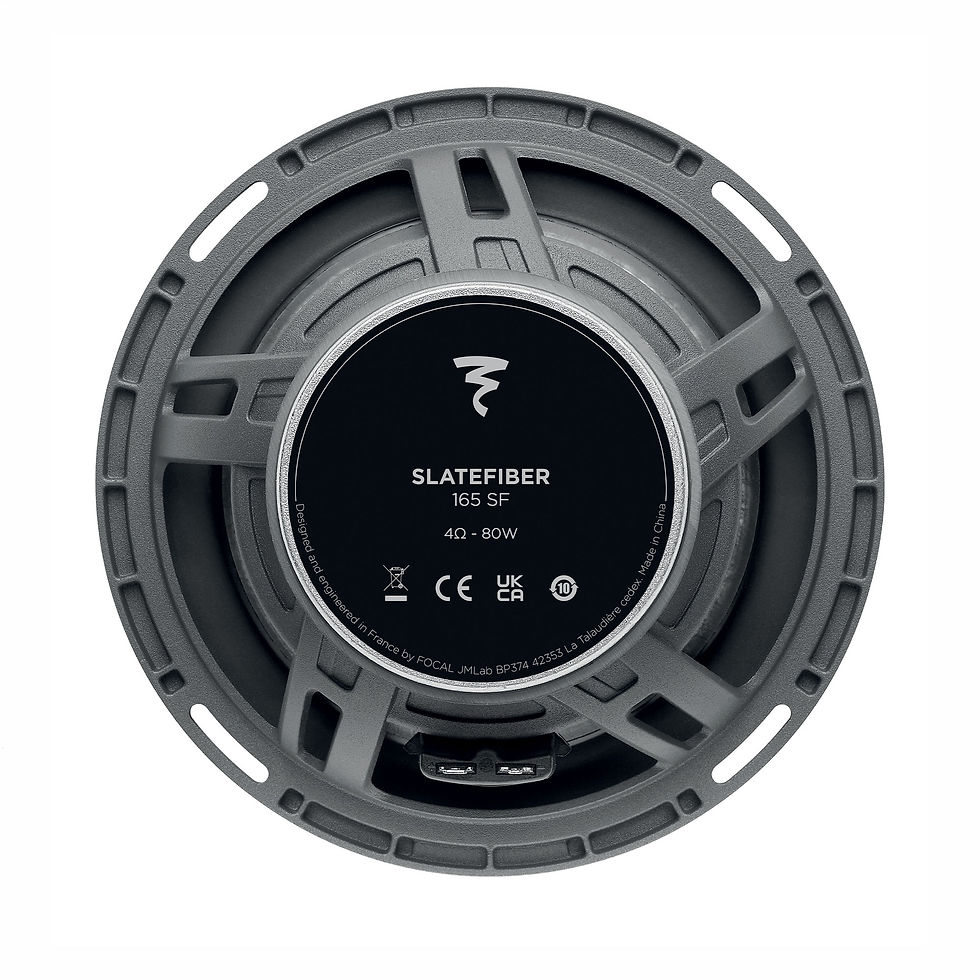
The Focal Slatefiber 165 SF is a 2-way component kit aimed at sound-quality-focused front-door installations. Its configuration is 165 mm Slatefiber woofers and separate Al/Mg tweeters. At VA3 Car Studio in Ghaziabad, choosing this product should begin with a fitment and system-design discussion rather than a promise that changing speakers automatically creates high-end sound. This guide interprets the manufacturer's published specifications, practical installation constraints and independent owners' comments. It is an evidence-based buying guide, not a claim that we performed a measured laboratory listening test on this particular product.
Specifications explained without marketing exaggeration
The stated nominal rating is 80 watts RMS, with 160 watts maximum and sensitivity of 91 dB. The stated response range is 60 Hz to 21 kHz under the manufacturer's specified conditions. RMS power is a thermal/handling guideline, not an instruction to feed that wattage continuously, and maximum power is not a meaningful continuous-output target. Sensitivity figures are useful for context but do not tell us how loud or balanced this exact speaker will sound inside a car door. Always compare like measurement conditions.
Focal lists Fs 66.8 Hz, Vas 11.72 L, Qts 0.592, Sd 132 cm² and Xmax 4 mm for the 165 SF woofer. These are useful when considering door leakage, excursion and integration with a subwoofer, but they are not a predicted in-car bass curve.

What the dimensions mean in a real vehicle
The 165 SF is most relevant for sound-quality-focused front-door installations. Before ordering, inspect the factory cut-out, mounting depth, window-glass travel, moisture barrier, seat or dashboard clearance, grille height and electrical connector arrangement. Speaker diameter is only the nominal class; matching a nominal 165 mm opening does not guarantee compatible bolt holes or a safe depth. We prefer taking physical measurements and testing the door card before final assembly. The wrong spacer thickness can produce rattles, blocked drainage or a window collision despite the correct nominal diameter.
Amplifier matching in practice
For a 80 W RMS-rated 2-way component kit, the objective is clean available power and controlled system levels, not automatically the largest amplifier. Verify impedance and the amplifier's genuinely specified continuous output. An external amplifier can improve clean headroom where a factory radio clips on musical peaks; it will not fix weak door sealing or an overly bright acoustic balance. Set gain using a known test signal and the correct measurement procedure rather than matching knob positions between channels. A DSP offers flexibility, but cannot repair gross installation errors or create missing cone excursion.
Crossover and DSP starting strategy
Treat crossover recommendations as commissioning starting points that must be verified with acoustic measurements. For a typical door midbass and tweeter setup, do not choose a crossover merely because a published response starts at a low frequency. The high-pass depends on door loading, power and excursion, while tweeter integration depends on the actual passive or active network. Recheck phase, polarity and crossover summation at the listening location.
Door treatment, baffles and mounting
Good damping reduces panel vibration, but a speaker also needs a rigid mount and a sensible acoustic seal. Fix gaps between the woofer and door trim to limit front-to-rear cancellation and preserve midbass efficiency. Keep water paths and service access intact; waterproof materials should not obstruct drainage. Check factory wiring polarity and door harness condition. These practical jobs are rarely glamorous in promotional photographs, yet an improperly sealed mounting ring can obscure the difference between models far more expensive than this Slatefiber kit.
Treble balance and listening fatigue
Several publicly available Focal owner discussions describe excellent detail, while others find some installations forward in the upper midrange or treble. These accounts refer to various Focal generations and models, not necessarily the exact 165 SF. They should therefore guide evaluation questions, not be quoted as evidence that this specific product is harsh or smooth. Tweeter angle, reflective glass, listener position, source equalisation and the crossover all matter. Listen to familiar voices and cymbals at normal volume before deciding whether extra treble reduction is needed.
Price and value in India
The Indian MRP entered in the VA3 Car Studio catalogue is ₹59,999, and the current listed selling price for this product is ₹51,000, representing roughly 15% off subject to rounding. These prices are store listings, not independently audited nationwide market quotations. Budget separately for baffles, damping, suitable wiring, amplification where required, and tuning. Sometimes a less costly driver with a carefully fabricated door and well-tuned crossover produces a more convincing daily-listening result than an expensive driver fitted without attention to basics.
How to evaluate the finished system
Use level-matched familiar tracks, and listen from the actual driver's seat with doors closed and the ventilation setting used every day. Measure left and right independently with a calibrated microphone and appropriate noise averaging, then inspect phase relationships and adjust crossover regions conservatively. Avoid attempting to flatten extremely narrow comb-filter dips with large EQ boosts. A useful final test is long-term comfort at normal listening volume, not a short loud demonstration. Document the final amplifier levels and DSP settings so future servicing does not undo the work.
Verdict: who should shortlist the 165 SF
The Focal 165 SF makes the most sense if your build needs sound-quality-focused front-door installations, and you value its specific 2-way component kit layout. Its published specifications define a credible engineering starting point, while the final performance depends strongly on correct fitment, amplification and acoustic calibration. We recommend pairing any purchase with an installation plan and candid listening comparisons. The article links below provide the live VA3 listing, the manufacturer's technical page and the actual community feedback cited, so readers can assess both the strengths and uncertainties directly.
Model-specific installation analysis
The Slatefiber 165 SF is a conventional-size two-way component kit with separately mounted tweeters. Its major advantage over C 165 SF is tweeter positioning for staging, but achieving a coherent crossover between a low door woofer and a higher tweeter location requires angle and phase checks.
What to compare before buying
A relevant alternative is Focal C 165 SF. The buyer should compare the driver layout, required fitting work and planned acoustic role before treating the higher-priced item as automatically superior. Component Slatefiber kit enables independent tweeter aiming and front image control. This is the distinguishing engineering or installation decision for this model, not proof of better measured sound in any particular vehicle. Before installation, confirm the vehicle aperture, mounting depth, speaker impedance, existing amplifier filtering and appropriate crossover protection. A nominal driver size is never a complete fitment guarantee.
Real-world reviews and limitations
We did not validate an attributable listening review for this exact current-generation 165 SF two-way kit. Search results often mix it with the earlier PS 165 SF; do not assume the two have identical driver assemblies, crossovers or listening character. Focal's current technical sheet documents Fs 66.8 Hz, Vas 11.72 L, Qts 0.592 and 4 mm Xmax for the woofer. For buyer confidence, request a demonstration with the complete 165 SF crossover/tweeter arrangement in a treated car door.
Frequently asked questions
165 SF versus C 165 SF?
Pick 165 SF for a deliberate front-stage build with separate tweeters; pick the coaxial C 165 SF when tweeter locations are impractical.
What must I check before installing Focal 165 SF?
Confirm the vehicle-specific cut-out, depth, grille, electrical loading and filtering. For this particular product, component Slatefiber kit enables independent tweeter aiming and front image control.
Can I assume the factory amplifier is sufficient?
No universal answer is possible. Check amplifier impedance compatibility, actual clean output, factory EQ and available headroom; an external amplifier or DSP may be useful but must be designed around the speakers and vehicle.
Does the published frequency range guarantee that response in my car?
No. Cabin geometry, installation baffle, enclosure, equalisation, crossover settings and listening position can all change in-car response. Use published figures for selection and measurements for tuning.


Comments