Focal 65 SF Review: Specifications, Fitment and Comparisons

Quick summary: the actual buying decision
Focal 65 SF is best evaluated according to the specific system requirement: 65 mm midrange is not a full-range door speaker; needs high-pass protection and matched woofer/tweeter. Verify the installation requirements before ordering rather than buying on maximum-power numbers alone.
Focal 65 SF: what this review actually covers
The Focal Slatefiber 65 SF is a wideband midrange pair aimed at A-pillars or carefully fabricated dashboard pods in a three-way installation. Its configuration is 65 mm dedicated midrange drivers. At VA3 Car Studio in Ghaziabad, choosing this product should begin with a fitment and system-design discussion rather than a promise that changing speakers automatically creates high-end sound. This guide interprets the manufacturer's published specifications, practical installation constraints and independent owners' comments. It is an evidence-based buying guide, not a claim that we performed a measured laboratory listening test on this particular product.
Specifications explained without marketing exaggeration
The stated nominal rating is 40 watts RMS, with 80 watts maximum and sensitivity of 87 dB. The stated response range is 250 Hz to 11 kHz under the manufacturer's specified conditions. RMS power is a thermal/handling guideline, not an instruction to feed that wattage continuously, and maximum power is not a meaningful continuous-output target. Sensitivity figures are useful for context but do not tell us how loud or balanced this exact speaker will sound inside a car door. Always compare like measurement conditions.
The standalone 65 SF technical sheet gives Fs 230 Hz, Vas 0.12 L, Qts 1.0 and Xmax 2 mm. Its published response is 250 Hz–11 kHz. These figures explain why it must be high-passed appropriately and why a large-excursion door-midbass task would be unsuitable for a 65 mm midrange.
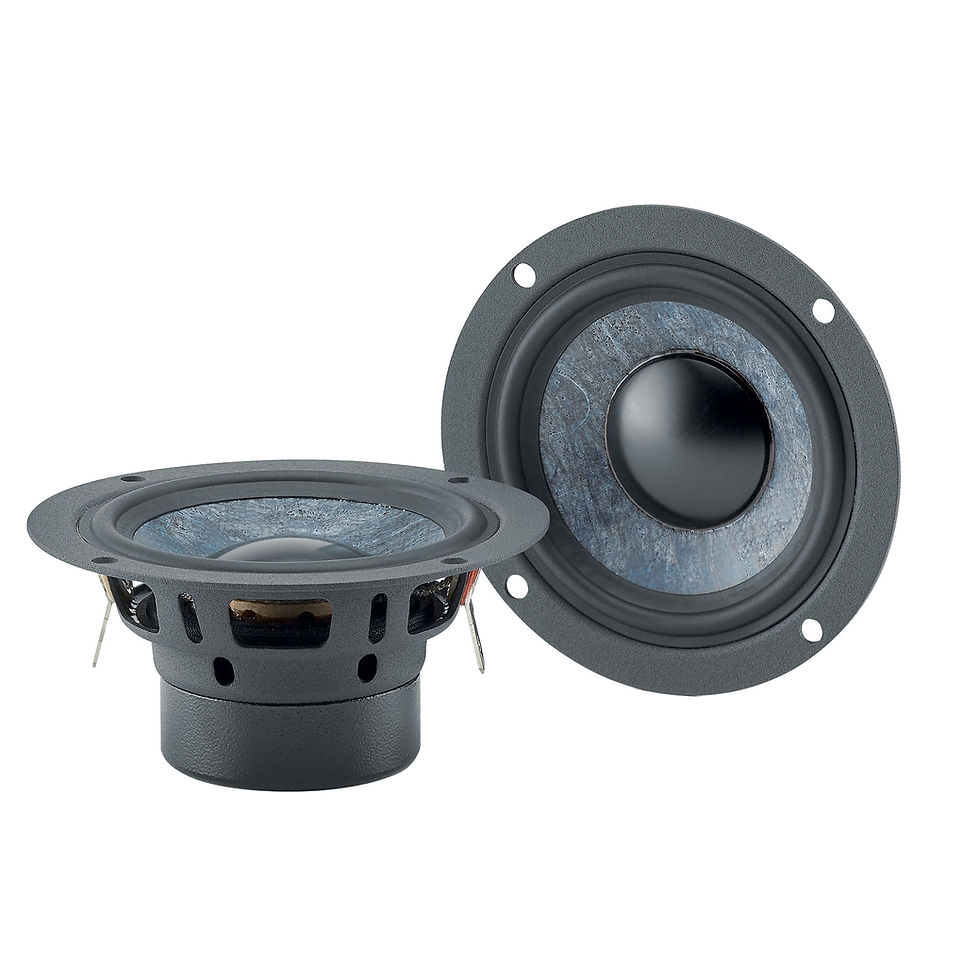
What the dimensions mean in a real vehicle
65 SF is a compact 65 mm midrange for a pillar or dash location, not a 165 mm door woofer. Verify cut-out, mounting depth and grille clearance at the chosen pillar or dash location, then design the pod around the speaker's rear-wave and mechanical protection requirements. Protect it with a correctly engineered high-pass and match its acoustic response to the door woofer and the tweeter.
Amplifier matching in practice
For a 40 W RMS-rated wideband midrange pair, the objective is clean available power and controlled system levels, not automatically the largest amplifier. Verify impedance and the amplifier's genuinely specified continuous output. An external amplifier can improve clean headroom where a factory radio clips on musical peaks; it will not fix weak door sealing or an overly bright acoustic balance. Set gain using a known test signal and the correct measurement procedure rather than matching knob positions between channels. A DSP offers flexibility, but cannot repair gross installation errors or create missing cone excursion.
Crossover and DSP starting strategy
Treat crossover recommendations as commissioning starting points that must be verified with acoustic measurements. Protect the small wideband midrange with a sufficiently steep high-pass, account for distortion and excursion, then integrate it with door woofers and tweeters using measurements. Recheck phase, polarity and crossover summation at the listening location.
Midrange pod construction and fitting
The 65 SF is a small 65 mm midrange for a correctly designed pillar or dash pod. Do not install it like a 165 mm door midbass. Check rear-wave management, available air space, angular alignment and whether a sealed or vented mounting environment is appropriate for the manufacturer's midrange parameters. The official sheet gives Fs 230 Hz and Xmax 2 mm, so reliable high-pass protection is essential.
The vocal band, off-axis response and tweeter handover
Use spoken voice, piano and guitar recordings to assess the 65 SF because its role is midrange. Its official stated response reaches 11 kHz, but that does not imply it should replace the tweeter automatically. Determine the upper crossover from directivity, distortion and measured summation with the chosen high-frequency driver. An aggressively aimed pillar speaker can make the vocal image unnatural even with a flat on-axis trace.

Price and value in India
The Indian MRP entered in the VA3 Car Studio catalogue is ₹39,999, and the current listed selling price for this product is ₹34,000, representing roughly 15% off subject to rounding. These prices are store listings, not independently audited nationwide market quotations. Budget separately for baffles, damping, suitable wiring, amplification where required, and tuning. Sometimes a less costly driver with a carefully fabricated door and well-tuned crossover produces a more convincing daily-listening result than an expensive driver fitted without attention to basics.
How to verify a three-way midrange installation
Run the 65 SF midrange independently with its protective filters enabled, take close-range and driving-position measurements, and then check summation against the door woofer and tweeter. The front stage should retain a stable vocal image as listening level changes. Document the final high-pass and low-pass settings to avoid exposing the small 2 mm excursion driver to low-frequency content later.
Verdict: who should shortlist the 65 SF
The Focal 65 SF makes the most sense if your build needs A-pillars or carefully fabricated dashboard pods in a three-way installation, and you value its specific wideband midrange pair layout. Its published specifications define a credible engineering starting point, while the final performance depends strongly on correct fitment, amplification and acoustic calibration. We recommend pairing any purchase with an installation plan and candid listening comparisons. The article links below provide the live VA3 listing, the manufacturer's technical page and the actual community feedback cited, so readers can assess both the strengths and uncertainties directly.
Model-specific installation analysis
65 SF is a specialist 65 mm midrange pair rather than a full-range replacement for door speakers. Its use requires a suitable high-pass, upper crossover to tweeters and careful pillar or dash-pod construction. Avoid a large sealed pod unless its internal air volume and damping have been considered; the mounting environment modifies midrange response.
What to compare before buying
A relevant alternative is Focal 165 SF. The buyer should compare the driver layout, required fitting work and planned acoustic role before treating the higher-priced item as automatically superior. 65 mm midrange is not a full-range door speaker; needs high-pass protection and matched woofer/tweeter. This is the distinguishing engineering or installation decision for this model, not proof of better measured sound in any particular vehicle. Before installation, confirm the vehicle aperture, mounting depth, speaker impedance, existing amplifier filtering and appropriate crossover protection. A nominal driver size is never a complete fitment guarantee.
Real-world reviews and limitations
We did not establish a verified owner listening report specifically for the new standalone 65 SF midrange. Comments praising a complete PS 165 SF or a different Slatefiber kit are not evidence for this 65 mm driver's sound. The useful evidence for system design comes from the 2026 Focal sheet: Fs 230 Hz, Xmax 2 mm and its stated 250 Hz–11 kHz response. A meaningful field review would disclose the pillar-pod size, lower and upper acoustic crossover, mating drivers, amplifier/DSP and time alignment.
Frequently asked questions
Can I run 65 SF without a tweeter or door woofer?
It is intended as part of a multi-way system; do not expect it to reproduce full-range bass and treble alone.
What must I check before installing Focal 65 SF?
Confirm the vehicle-specific cut-out, depth, grille, electrical loading and filtering. For this particular product, 65 mm midrange is not a full-range door speaker; needs high-pass protection and matched woofer/tweeter.
Can I assume the factory amplifier is sufficient?
No universal answer is possible. Check amplifier impedance compatibility, actual clean output, factory EQ and available headroom; an external amplifier or DSP may be useful but must be designed around the speakers and vehicle.
Does the published frequency range guarantee that response in my car?
No. Cabin geometry, installation baffle, enclosure, equalisation, crossover settings and listening position can all change in-car response. Use published figures for selection and measurements for tuning.


Comments