Onkyo R-MP350 Review: 4-In 8-Out DSD DSP Amplifier With 4 x 80 W Max

The Onkyo R-MP350 is a 4-in 8-out DSP amplifier with four high-level inputs, optical and coaxial inputs, eight low-level outputs and a built-in four-channel amplifier that Onkyo lists at 4 x 80 W maximum. Onkyo's page also describes it as DSD with DSP amplifier. Its Indian MRP is ₹49,990, level with the R-MS69 and ₹15,000 below the R-MS76 among the Onkyo units we list. It suits a build that needs four amplified channels from a factory head unit or from a source with digital outputs. The amplifier is on our Onkyo R-MP350 product page.
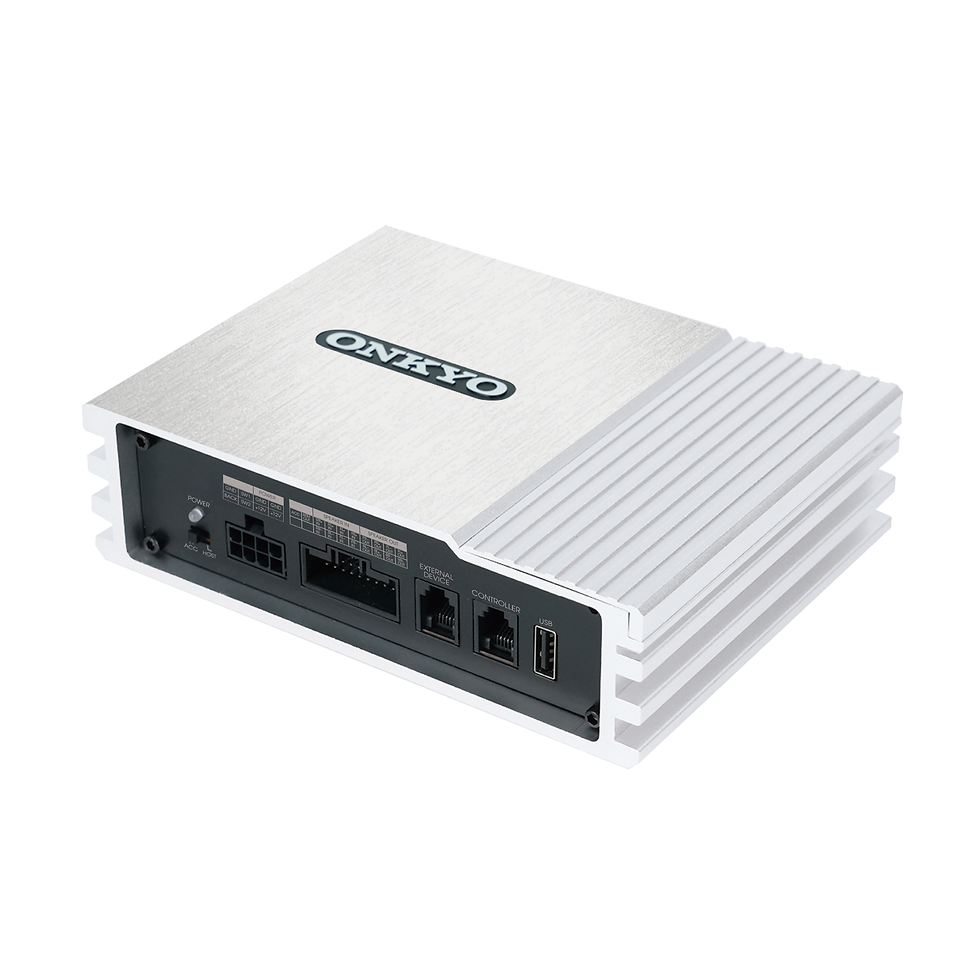
Quick summary
Four high-level inputs, optical, coaxial, Bluetooth music, USB device and phone OTG inputs, eight low-level outputs and four channels at 4 x 80 W max. Onkyo publishes no RMS figure.
A 31-band equaliser with six preset music scenes, a 20 Hz to 40 kHz frequency response and a 6 to 18 V supply range.
On Onkyo's page DSD appears only as a one-line description: no DSD rates, input or playback method are published. No low-level input is listed either.
We found no owner reviews or independent tests in October 2026.
Onkyo R-MP350 specifications
Specification | R-MP350 |
|---|---|
Type | DSP amplifier, 4-in / 8-out, DSD label |
Maximum power | 4 x 80 W (max only; no RMS rating listed) |
Inputs | 4-channel high level, optical, coaxial, Bluetooth music, USB device, phone OTG |
Outputs | 8-channel low level, 4-channel high level |
Equaliser | 31-band, 6 preset music scenes |
Frequency response | 20 Hz – 40 kHz |
High-level input | 50 Ω (Onkyo's label: Input Power) |
Power supply | DC 6 – 18 V |
Dimensions | 165 x 124 x 46 mm |
Weight | Approx. 1.03 kg |
Setup software | Onkyo R-MP350, PC and Android (per our listing) |
Not listed | RMS power, crossover, time delay, remote, Bluetooth version or codec, DSD rates |
India MRP | ₹49,990 |
Figures come from Onkyo's R-MP350 product page and our store listing, which agree on every figure. Our listing reads Onkyo's 50 Ω entry as high-level input impedance. It also notes that the unit is listed as R-MS350 in the Onkyo India 2026 catalogue, so you may see either name.
What the DSD label does and doesn't tell you
DSD appears in two places. Onkyo's page carries it only as a one-line description, DSD with DSP amplifier, and our listing calls the unit DSD-capable. Neither gives a DSD rate, names the input that carries DSD or describes how it is played back. None of the other seven Onkyo DSP amplifiers we list carries a DSD label.
The inputs around it are no clearer. USB device and phone OTG are listed without formats, file systems or phone support, optical and coaxial without sample rates, and Bluetooth music without a version or codec. If DSD playback is your reason for choosing this unit, get those details from Onkyo before you order.
4 x 80 W max, a 6 to 18 V supply and eight outputs
Onkyo lists the amplifier as MAX Power only: 80 W on each of four channels, with no stated load, test voltage or distortion figure. Max is not continuous output, and the gap to RMS varies by maker. Zapco's manual pairs 23 W RMS at 4 Ω with 70 W max on each channel of the HB 46 II 4A, while Morel's datasheet gives the MDSP 8/4A 80 W RMS per channel at 4 Ω, the same number on a different basis. We won't turn Onkyo's 80 W into RMS.
Onkyo lists a DC 6 to 18 V supply, wider than the 9 to 16 V on Onkyo's R-MS66 page, a model our live R-MS66 post covers. Car voltage can sag at idle with the AC on, but Onkyo doesn't say what output power or noise do near either end of the range. The eight low-level outputs can feed external amplifiers, for example for a subwoofer, and neither source says how they map onto the four high-level outputs.
Inputs, sources and tuning
Four high-level inputs take speaker-level signals from a factory head unit, for example a front and a rear pair, and the optical and coaxial inputs take digital signals from a media player or aftermarket head unit. No low-level (RCA) input is listed, so a head unit with only RCA pre-outs has no listed input to use. The R-MS26, R-MS69 and R-MS76 each list two.
Tuning uses Onkyo's R-MP350 software for PC and Android, per our listing. Onkyo's download page lists separate R-MP350 downloads with no version numbers or manual, so their controls aren't documented there, and the product page lists no crossover or time-delay controls. The listed tools are a 31-band equaliser and six preset music scenes. VA3 Car Studio offers DSP tuning for a unit like this.
What owners and reviewers say about the Onkyo R-MP350
When we checked in October 2026, we found no owner reviews, forum threads or independent tests of the R-MP350, searching under both R-MP350 and R-MS350. Onkyo's page is a specification table, which is promotional rather than a review, and our listing shows no customer reviews. Sound quality, software behaviour and DSD handling are therefore unverified. If you own an R-MP350, tell us how it has gone.
R-MP350 against the R-MS26, Zapco HB 46 II 4A and Morel MDSP 8/4A
Listed figure | R-MP350 | Onkyo R-MS26 | Zapco HB 46 II 4A | Morel MDSP 8/4A |
|---|---|---|---|---|
India MRP | ₹49,990 | ₹20,990 | ₹21,990 | ₹59,990 |
Amplified channels | 4 | 4 | 4 | 4 |
Power rating | 4 x 80 W max | 4 x 50 W max | 4 x 23 W RMS at 4 Ω (70 W max) | 80 W x 4 RMS at 4 Ω |
High-level inputs | 4 | 4 | 4 | 8 |
Low-level inputs | None listed | 2 | 2 | 2 |
The R-MS26 lists two low-level inputs and 4 x 50 W max, with optical but no coaxial input, for ₹29,000 less. The R-MP350 lists a coaxial input, 4 x 80 W max against 4 x 50 W and a DSD label; neither source says how these perform. At the same MRP the R-MS69 lists eight amplified channels and two low-level inputs but no DSD label. The Zapco and Morel publish RMS ratings, and Zapco lists crossover, delay and phase controls; Onkyo's R-MP350 page lists none of these.
Who should buy it, and who shouldn't
Buy the R-MP350 if you want four amplified channels with optical and coaxial inputs, can get the DSD details you need from Onkyo first, and accept a max-only rating. Look elsewhere if you need a low-level input (the R-MS26 lists two), more than four amplified channels at the same MRP (the R-MS69), or published RMS power with documented crossover and delay controls (the Zapco above).
Installation notes for Indian cars
At 165 x 124 x 46 mm and about 1.03 kg, the R-MP350 needs a flat, ventilated spot away from heater ducts and direct sun, since a closed cabin gets very hot in an Indian summer and Onkyo lists no operating temperature range. Onkyo also publishes no current draw or fuse rating, so the power feed has to be sized at fitting. Four high-level inputs can mean up to four speaker-wire pairs to identify at a factory touchscreen head unit.
VA3 Car Studio in Ghaziabad offers professional installation, makes speaker pods and door baffles for the speakers the amplifier drives, and builds custom subwoofer boxes if a subwoofer joins the low-level outputs.
Price and where to buy
The Onkyo R-MP350 has an MRP of ₹49,990. VA3 Car Studio often sells below MRP, so check the current price on the R-MP350 listing. Warranty terms are set by Onkyo; confirm them with us before ordering.
The bottom line
The R-MP350 lists four amplified channels, optical and coaxial inputs, a 6 to 18 V supply range and a DSD label, at an MRP of ₹49,990. Its max-only rating, no listed low-level input, thin DSD documentation and lack of reviews mean the details that matter to you are worth confirming before you order.
Onkyo R-MP350 FAQ
Does the Onkyo R-MP350 play DSD files?
Our listing calls it DSD-capable and Onkyo's page carries a one-line DSD description, but neither gives DSD rates, the input that carries DSD or a playback method, so we can't say what files it plays.
Is the R-MP350 the same as the R-MS350?
Our listing says the R-MP350 is listed as the R-MS350 in the Onkyo India 2026 catalogue, while Onkyo's own product page uses R-MP350. Confirm the model name with us before ordering.
Is the R-MP350's 4 x 80 W an RMS rating?
No. Onkyo publishes 80 W per channel as MAX Power only. It is not continuous output, and the page gives no load or test-voltage figure for it.


Comments